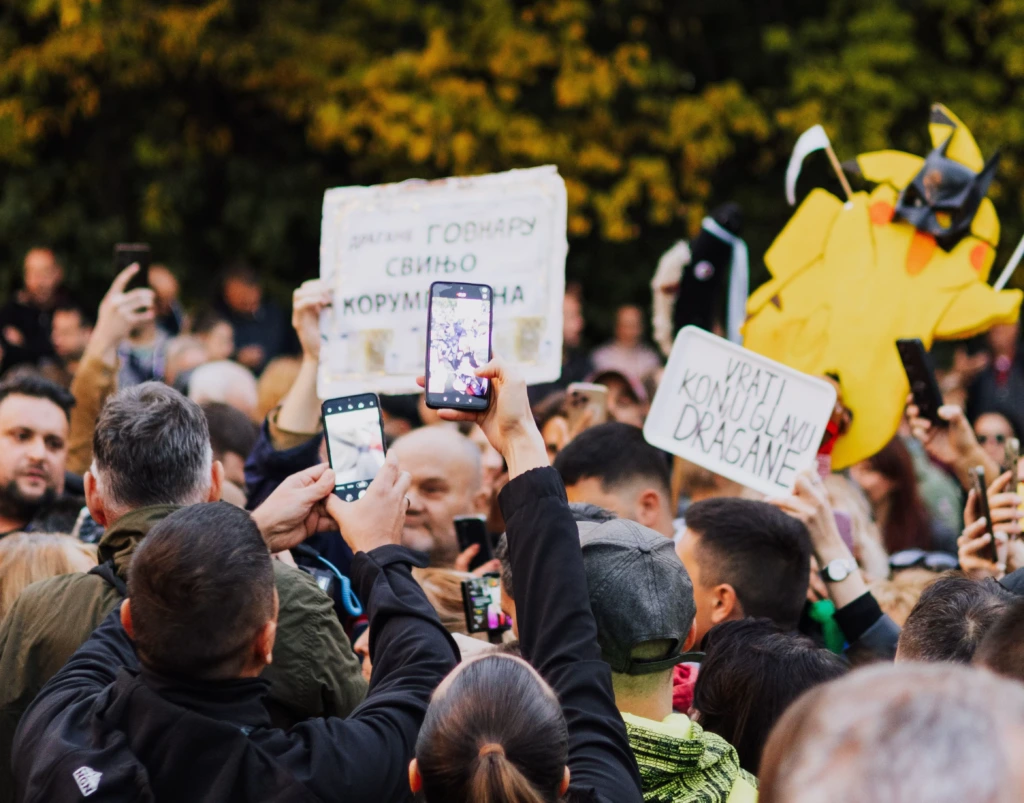
One of the key factors behind the student movement’s success was the establishment of plenary meetings and assemblies at universities across the country. During these coordinated gatherings, students debated issues, formulated their demands, developed strategies and voted on key decisions. This approach to organising proved particularly important, as it helped transform public outrage over the Novi Sad railway station tragedy into coordinated action.
The students’ eleven-point plan, developed during these assemblies, outlined a series of anti-corruption measures. It called for media and judicial independence, affordable housing, investment in rural healthcare, greater transparency in public procurement and the removal from public life of individuals connected to Vučić’s clientelist networks.
Social Media as a Counterweight to Government-Controlled Media
Alongside university assemblies, protest marches and mass gatherings played an important role in reaching and gaining the support of people living in rural areas. These communities often had limited access to independent sources of information and were therefore reliant on pro-government media, including the public broadcasters Radio Television of Serbia (RTS) and Radio Television of Vojvodina (RTV), which had become mouthpieces for the ruling party.
The politicisation of the media and its use as a tool of political influence were most clearly reflected in the disproportionate visibility of Vučić and the ruling Serbian Progressive Party (SNS). According to CRTA, a Belgrade-based non-governmental organisation, the ruling party received 90 per cent of airtime on national television channels in 2024, compared with just 10 per cent for the opposition. Meanwhile, the then-president appeared on television a total of 354 times.
Pro-government media also actively spread disinformation and sought to discredit students, portraying them as “blockaders” attempting to overthrow the regime and allegedly backed by foreign institutions.
While politicians in power often rely on controlling traditional print and television media, online news portals and social media have proved considerably more difficult to control, partly because of their international reach. These platforms played a crucial role in communicating students’ demands and exposing government corruption.
Facebook and Instagram became important tools for mobilising Serbian citizens both at home and among the diaspora abroad. They also helped attract the attention and support of the international community, including the European Union (EU).
Meanwhile, X and TikTok were used in a more informal way. Students shared humorous posts, emotional reflections and glimpses of everyday life during mass gatherings and blockades. This content helped them gain sympathy, support and respect from ordinary people across the region.
A Leaderless Movement Secures a Historic Election Victory
How did the students manage to secure a historic victory for the Student List and bring an end to Vučić’s 14 years of authoritarian rule?
One reason was that the student-led movement had no single leader. This made it considerably harder for pro-government media to single out an individual and target them with smear campaigns, as had often happened to opposition figures during previous election campaigns.
Furthermore, the students sought to distance their movement from traditional party politics. This was reflected in the composition of the Student List, which included professionals and artists from various fields, many of whom had little or no previous political experience.
In previous Serbian elections, Vučić’s victories had largely been secured by a fragmented, relatively small, often corrupt and centralised opposition that had become disconnected from the everyday concerns of ordinary citizens.
Despite initial fears of electoral fraud and police repression on election night, 25 October, the former president conceded defeat to the Student List. The movement achieved a historic victory, winning 52.7 per cent of the vote and securing 140 of the 250 seats in the National Assembly. By comparison, Vučić’s United Serbia received 39.17 per cent of the vote and won 104 parliamentary seats.
The students’ remarkable success can partly be attributed to exceptionally high voter turnout. According to the non-governmental organisation CRTA, turnout reached 68.78 per cent.
The Students’ Victory Marks Only the Beginning of Change
Just days after the students’ victory in Serbia, significant changes were already under way. Slogans and posters featuring the former president and the SNS were being removed, while Pioneer Park, which had served as the “residence” of Vučić’s criminal group, had been cleared and was being restored. Efforts had also begun to remove individuals linked to his clientelist networks through arrests and pressure to resign.
In a historic move, RTV apologised to Serbian citizens for its biased reporting during Vučić’s rule: “For many years, the public broadcaster failed to fulfil its role. It remained silent, turned a blind eye, presented information from only one perspective, reported uncritically, failed to ask the right questions or asked no questions at all. For this, we owe our viewers an apology.”
Nevertheless, although the students’ victory marks a turning point for democracy in Serbia, the country still has a long way to go before it can fully free itself from the former regime’s clientelist networks and interests linked to criminal organisations.
Under the recently ousted regime, major infrastructure projects and public investments were financed and managed through networks of subcontractors and criminal organisations that were not required to provide comprehensive documentation, justify their activities or comply with legal standards.
Dismantling the deeply entrenched structures associated with the former president and ruling party will require time, strong public support and determined action by the Student List once the new government is formed next year.
Moreover, Serbia stands at a geopolitical crossroads between the EU and Vučić’s eastern allies, Russia and China. It remains uncertain how these relationships will evolve following the Student List’s victory, or how Russia and China will respond to the students’ declared commitment to continuing Serbia’s path towards European integration.
A Wave of Protests Across Europe: Different Causes, Shared Discontent
Serbia’s student movement and its subsequent victory could serve as an example for other social movements currently unfolding across Europe, including in Spain, Portugal, Belgium, France and neighbouring Albania.
Most of these protests have been driven by dissatisfaction with housing costs, conditions in the education system, low wages and longer working hours. In Albania, the demonstrations have been more closely linked to political issues and corruption.
Lithuania is no exception. As recently as April this year, thousands of people took to the streets to express their dissatisfaction with the politicisation of the public broadcaster.
More broadly, civic activism in Lithuania has increased significantly since September 2025, when the Lithuanian government handed control of the Ministry of Culture to the populist Nemuno Aušra (Eng. Nemunas Dawn) party, which has been associated with anti-European, antisemitic and pro-Russian narratives.
Although protests across EU Member States have largely focused on education and housing conditions, these issues can also be understood in a broader context, reflecting corruption, public dissatisfaction and declining trust in political elites and democratic institutions. This reveals parallels with Serbia’s student movement.
Peaceful Resistance: The Strength of Serbia’s Student Movement
Unlike in Serbia, where students remained peaceful despite police violence, protests in several EU countries, including France and Italy, have resulted in violent clashes between demonstrators and law enforcement officers.
One reason why Serbia’s student movement remained peaceful was the students’ determination to break the cycle of violence and repression that had shaped the country and the wider region for years following the rule of Slobodan Milošević.
Through strict discipline, resilience and a commitment to non-violent forms of protest, Serbian students managed to earn public trust, respect and support.
By refusing to accept the authoritarian government’s attempts to portray protesters in the media as violent destabilising forces and foreign agents, the students undermined the credibility of state propaganda and gained widespread public sympathy.
Students and citizens in other European countries and across the world could therefore benefit from adopting the alternative model of political action developed by Serbian students. This approach is based on peaceful gatherings and marches, alongside plenary assemblies in which demands are clearly formulated and debated, and strategies are developed.
Serbian students have demonstrated that even under authoritarian rule, resistance is possible through perseverance, creativity and a consistent commitment to principled non-violence.