KTU Strategy 2026–2030 defines the University’s strategic directions focused on strengthening the ecosystem of studies, research and innovation, fostering an engaging and creative community and contributing to societal well-being. The strategy also emphasises internationalisation, sustainability, interdisciplinarity, innovation and collaboration.

Kaunas University of Technology had its beginning on 16 February 1922, when the University of Lithuania and its technical faculties were established.
The development of Lithuanian scientific ideas continued in the first Lithuanian independent technical school of higher education (in 1950–1990 titled Kaunas Polytechnic Institute (KPI)). It was famous for the ultrasound and vibrotechnics laboratories, and scientific research of textiles.
In 1990 KTU regained its status of the university and took a path of rapid reforms of studies and research. The University continues to pursue sustainable partnership of science, business and industry, develops and implements new ideas, innovations and inventions.
Since 1922 more than 157 thousand graduates graduated from the university.
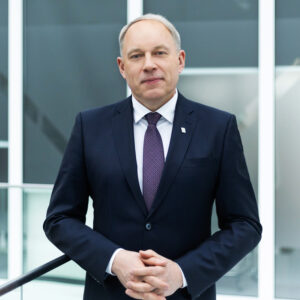
The Rector is the University’s sole executive body acting on behalf of and representing the University. Rectorate is the Rector’s advisory institution. The Rectorate consists of the Rector, Vice-Rectors, faculty Deans, the President of the Student Union, as well as heads of other divisions appointed by the Rector’s order.
KTU has cooperation agreements with more than 350 higher education institutions in 50 countries of the world. Memorandums of Understanding, Student and staff exchange and “Erasmus+” inter-institutional agreements allow the University to develop strategic partnerships with foreign institutions in studies and research, and for our staff and students to go for academic exchange. At the moment, most of our partners are from the European Union countries but the cooperation map is quickly expanding.
ECIU University is an innovative European University where challenge-based learning covers many activities: teaching and learning, research and development, and innovation.
Logo and style guide embody KTU identity and ensure a close relation between a particular publication and the University. In this section you will find the University’s logo and the coat of arms, and other resources, such as KTU soundtrack by the German music group De-Phazz. For the correct usage of the University’s logo, please check the style guide.
KTU acts in a responsible manner based on the common university values. Sustainable development which promotes responsible, environmentally-friendly behaviour and ecological culture is one of the priorities of KTU activities. The University maintains the attitude that new knowledge and technologies have to serve for the well-being of the people as well as the environment. KTU sustainable development strategy and activities were awarded the European Union’s QUESTE-SI accreditation.
The University’s quality management principles are inseparable from the development and implementation of the organisation’s strategic objectives, aspirations, priority activities and plans. The main objective of quality management at the University is to be a strong socially responsible organisation that fosters an academic environment – attracts motivated students and high-performing employees – by ensuring the integrity of quality management processes and the University’s strategy.
Kaunas University of Technology is the founder and co-founder of a number of educational institutions, both with partners and individually.
Membership from 1991
Initiator from 1997
Membership from 1998
Membership from 2000
Membership from 2001

Partner from 2005
Member of the Council from 2008

Membership from 2016
Membership from 2016
Membership from 2019
Membership from 2019
 Awarded 2020
 Membership from 2021