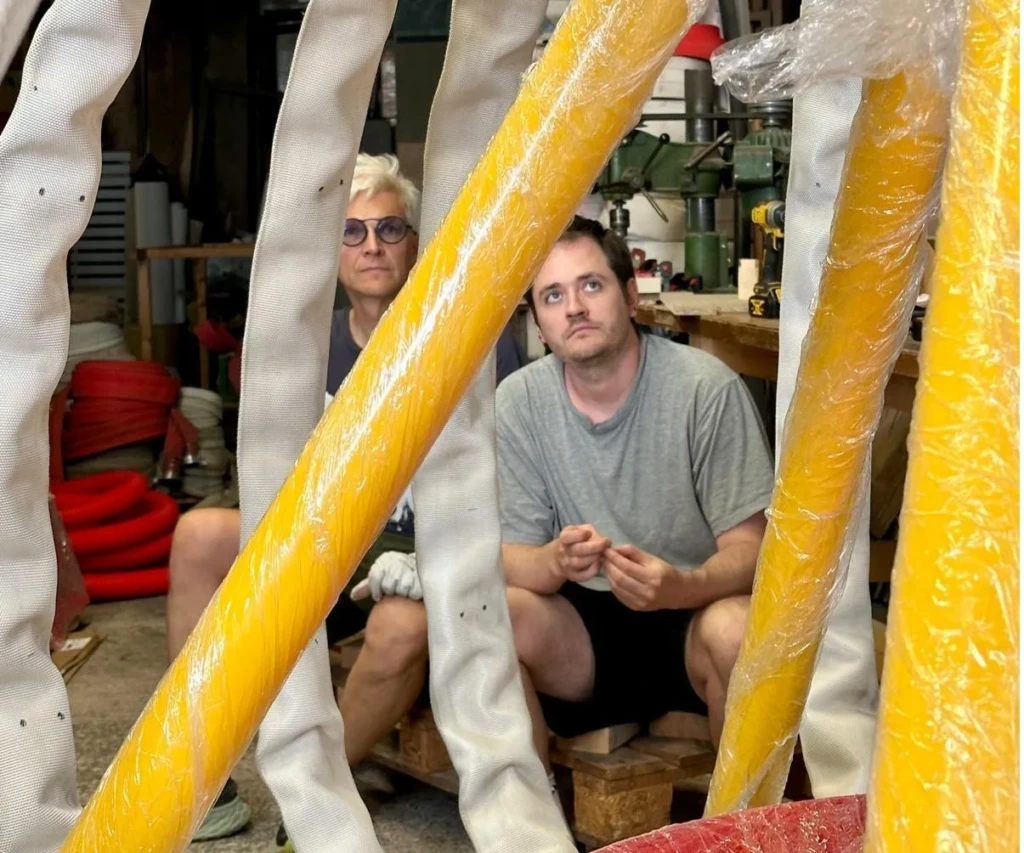
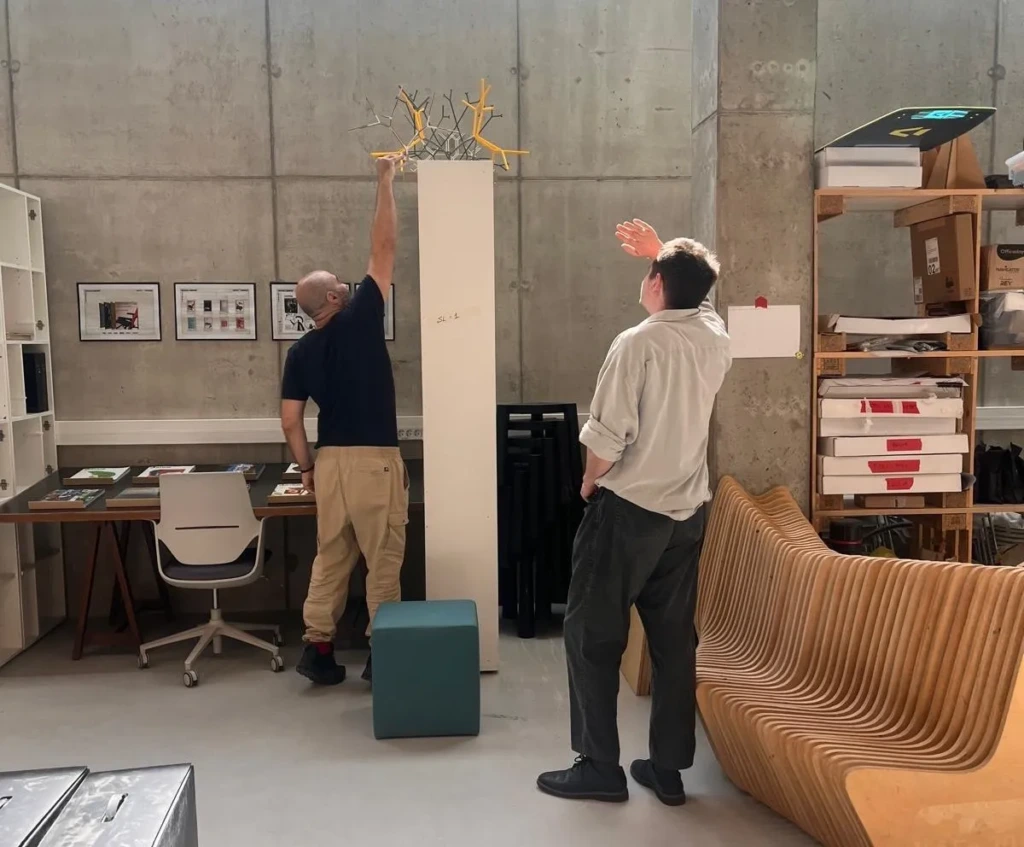
“Over time I became more familiar with Kaunas, but I was always appreciative of this eclectic mix of industrial and cultural places,” says Felde.
Reflecting on his stay, he says that travelling to a country whose language he does not understand gives him the opportunity to learn something new – including how to navigate a world he can only partly understand.
“I knew of Kaunas and Lithuania mostly from descriptions of the history of Poland from my partner, who is Polish and a historian. We both noticed many cultural commonalities between Poland and Lithuania,” he says.
The university environment, meanwhile, reminded him of MIT. “I noticed the similarities immediately and began to question why I came to KTU after just narrowly escaping MIT,” Felde says.
As his stay progressed, however, he also noticed differences: he found it much easier to get permission to use facilities and equipment at KTU, and people seemed more relaxed.
Why Study Art at a Technical University?
After completing his fashion studies in London, Felde wanted to explore the field in a broader context. That interest led him to MIT’s Art, Culture, and Technology (ACT) Program, which is part of the Department of Architecture within the School of Architecture and Planning.
“I always saw clothing and architecture in a similar realm, both interact and cover bodies but just at varying scales and flexibilities,” explains the artist, now an MIT alumnus.
Felde was interested not only in making clothes, but also in the meanings they communicate. Although his questions evolved, his interest in textiles as a medium for conveying memory remained.
He also chose MIT because, as a technology-focused university, it exists somewhat on the margins of the contemporary art world. Felde sees this as an advantage.
“I’ve worked in contemporary art in different cities throughout Europe, and I’ve noticed how it can feed off itself and fail to intervene or interact with anything else,” he says.
For Felde, there is also an undeniably practical side to studying art at MIT. “Things are scrutinised through different methods with tools that allow you to look extremely closely, in an uncanny way,” the artist says.
In his view, both art and science deal with the unknown and find ways to articulate it in new and familiar ways.
Finding Inspiration in What Others Throw Away
Felde’s work brings together themes of memory, maintenance and monumentality. He develops his ideas through sculpture, artistic actions and interventions, seeking new meanings in everyday materials and objects.
The artist says his creative process most often begins with scavenged or discarded objects. “I find waste to be very revealing and informative of a place, so I am often looking through dumpsters. I especially love when two objects from very different contexts fit perfectly together; this is the moment when work begins to emerge for me. I feel that as a species we have made enough things; now we just need to rearrange them,” says Felde.
Felde often incorporates details from everyday life into his work. He says that the very fact that we consider an object or material unremarkable is what makes it special. Firstly, it means that an object is so pervasive in our surroundings that we no longer notice it. Secondly, it is so well designed that it simply disappears into the scenography of daily life.
“To become interesting, on the other hand, is almost too easy. Try thinking of something that’s not interesting, then you’ve got my attention,” he says.
Now back in Berlin after completing his studies at MIT, Felde says he has brought something of Lithuania back with him. “The pillowcases made from Lithuanian linen have been influencing my dreams, which have a direct impact on my work,” says Felde, reflecting on his internship at KTU’s Design Centre.