Skip to content
Dark red background with a white open book and pencil icon, alongside the text “4 Quality Education.” Represents the goal of inclusive, equitable, and quality education for all.
Orange background with three connected white building blocks and the text “9 Industry, Innovation and Infrastructure.” Represents the development of resilient infrastructure and sustainable industrialization.
Navy background with five interlinked white circles forming a flower-like shape, and the text “17 Partnerships for the Goals.” Illustrates the goal of strengthening global partnerships to support sustainable development.

CERN Council President on the Future of Science: What Opportunities Lie Ahead for Lithuania?

Important | 2026-10-22

Europe risks losing its most talented scientists if it does not devote sufficient attention to research and advanced technologies. CERN Council President Prof. Costas Fountas, who visited Lithuania this week, discusses this threat, future scientific projects and the role of universities in them.

During his visit to discuss Lithuania’s ambition to become a full member of CERN, Prof. Fountas also visited Kaunas University of Technology (KTU), where he shared his insights on Europe’s technological competitiveness, next-generation particle accelerators and the training of scientists.

The CERN Council President was accompanied by members of the Lithuanian delegation: Rytis Paulauskas, Lithuania’s Permanent Representative to the United Nations (UN) in Geneva; Prof. Saulė Mačiukaitė-Žvinienė, Vice-Chair of the CERN–Lithuania Committee; and Artūras Malysis, Senior Specialist at the Ministry of Education, Science and Sport.

Engineering Solutions Behind Major Scientific Discoveries

Although CERN is most often associated with fundamental physics research, engineering is just as important to the organisation’s work. The technologies developed there not only enable complex scientific experiments but also foster collaboration with industrial companies.

“Most people think that only physicists work at CERN. In fact, there are many engineers, while physicists are in the minority. CERN is a high-tech engineering centre, and that matters to Europe and European companies. It is an ongoing two-way process: we obtain technologies from companies, provide them with feedback, receive feedback ourselves and test new solutions,” says the CERN Council President.

man with glasses and grey hair sitting at a table in a meeting
CERN Council President Prof. Costas Fountas

KTU Rector Prof. Eugenijus Valatka also highlights the importance of this kind of collaboration for universities.

“CERN’s work clearly shows how closely fundamental research and engineering are connected. The drive to answer complex scientific questions encourages the development of new technologies. This requires people who can bring together knowledge from different fields and work jointly to find solutions. It is important to foster this culture of collaboration at universities, too,” says the KTU Rector.

CERN Plans a Particle Accelerator Almost 100 Kilometres Long

One of CERN’s most important future projects is the Future Circular Collider (FCC), which could replace the Large Hadron Collider (LHC), currently in operation. The new accelerator’s ring is planned to be around 91 kilometres long, making it more than three times larger than the LHC, stretching 27 kilometres.

The strategic importance of the FCC project is reflected in the updated European Strategy for Particle Physics (ESPP), which identifies the FCC as a priority future CERN project.

Once the CERN Council approves the updated strategy, the FCC project is expected to move to its next major implementation stage: the Technical Design Phase. In preparation, the FCC collaboration memorandum of understanding has been updated, setting out the principles, terms and commitments governing cooperation among project partners. The memorandum is now ready to be signed by all FCC collaboration partners, including KTU.

According to Costas Fountas, the future accelerator is one of the main topics discussed by the CERN Council. Since building scientific infrastructure on this scale takes decades, CERN is already considering options for its further development.

“This is currently a topic of discussion at the CERN Council, and I devote most of my time to it. We are talking about a circular accelerator with a circumference of almost 100 kilometres. The energy of the particle beam is related to the radius of the ring: the larger the radius, the higher the energy that can be achieved,” he explains.

One of the biggest challenges facing the future accelerator is technological. Achieving higher particle energies requires extremely powerful magnets, whose development and manufacture take considerable time. As Fountas explains, the challenge is not only to design a magnet that works properly, but also to ensure that thousands of such devices can be manufactured.

two women and three men sitting at the table in an official meeting
At the meeting with CERN Council President at KTU

“Projects of this scale require consistent, advance preparation. We need to assess now how Lithuanian scientists and companies could contribute to the FCC, what expertise we have already developed and what we still need to learn. This would help us develop research and collaboration in a focused way,” says the KTU Rector.

Why Is It Important for Universities to Get Involved Now?

If the FCC project is approved, it will create new opportunities for CERN Member States, ranging from research and experimental development to industrial contracts. That is why, according to the CERN Council President, universities and research institutions need to start collaborating in the project’s early stages.

Speaking about the FCC’s prospects, he also stresses the importance of training young scientists. If the project goes ahead, the next generation of researchers will benefit from the opportunities it creates. Young researchers, scientists and engineers therefore need to be recruited well in advance.

“Now is the right time to get involved. We need young people to work on the FCC. If the project is implemented, it is scheduled to begin operating in 2048. This means we need to bring in young researchers and scientists and give them the conditions to start working,” says Fountas.

According to the KTU Rector, the university’s responsibility is to create conditions for young people to grow and find their place in science. It is important for students and doctoral candidates to get involved in research as early as possible, work with experienced scientists and build connections with colleagues in other countries.

“This kind of experience develops independence, confidence in one’s knowledge and the courage to ask questions. In this way, we prepare people who can contribute to projects that are still only being planned today,” he says.

Dr Brigita Abakevičienė, Head of CERN for the Baltic States, notes that the FCC project is an excellent example of why scientific decisions must be made today. Major research infrastructures take decades to build, so countries that invest early in expertise, research and industrial readiness can secure stronger positions in the value chains of future technologies.

“For the Baltic States, this is an opportunity to act not as three separate small countries, but as a region capable of bringing together its scientific, engineering and industrial potential. Our goal should be not only to use future CERN technologies in the Baltic States, but also to develop them here, at our universities,” she says.

What Would Full CERN Membership Mean for Lithuania?

Discussing Lithuania’s ambition to become a full CERN Member State, Fountas stresses that the benefits of membership go beyond participation in the organisation’s governance. Membership also creates opportunities for the country’s scientists, students and companies to take part in international research, technology development and industrial projects.

“Most people focus on the fact that full membership gives a country a seat on the CERN Council. In my view, however, that is not the most important benefit. Membership provides access to CERN contracts, the opportunity to send people to work at CERN, and closer links to one of the leading physics and technology centres in Europe, perhaps even the world,” says Fountas.

He adds that CERN membership also provides access to advanced technologies that individual research groups would otherwise find difficult to obtain. This experience is valuable for students as well, as they can later apply the skills they gain in the technology industry.

“Lithuania’s ambition to become a full CERN Member State should be seen not only as a science policy decision, but also as a long-term investment in the country’s technological competitiveness. CERN is a unique environment in which fundamental research drives the development of technologies that often go beyond the capabilities of today’s industry. For Lithuania, this is an opportunity not only to participate in world-class scientific projects, but also to help develop technologies that will shape the economy of the future,” says the Head of the CERN Baltic States group.

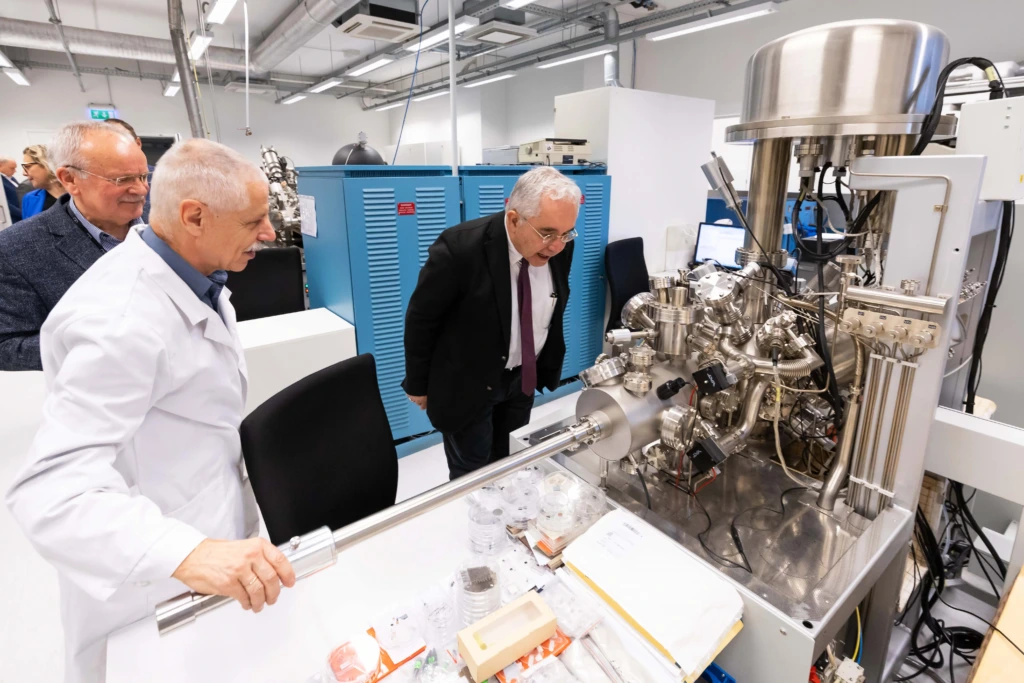
People at a science lab looking into machinery
CERN Council President at KTU Materials Science Institute laboratories

According to her, the Baltic States have strong expertise in lasers, photonics, electronics, information technology and advanced engineering. It is therefore important to pool these capabilities strategically and integrate them into CERN’s long-term research and technology development programmes.

Full CERN membership creates opportunities, but turning them into real projects, contracts, technologies and jobs requires sustained cooperation among universities, businesses and the state.

Artificial Intelligence Is Also a Matter of Geopolitical Competition

Although artificial intelligence (AI) has attracted considerable attention in recent years, Fountas points out that neural networks have been used in high-energy physics since the 1990s. Today, he says, AI development has also become a question of Europe’s technological autonomy.

“Europe is competing directly with the United States and China, especially China, and we are falling behind. We therefore need to take action to ensure the strategic independence of European industry. CERN cannot stand aside,” Fountas stresses.

He notes that CERN has already contributed to major technological advances, including the creation of the World Wide Web. In his view, the organisation can also contribute to the development of AI and language models.

“Many years ago, we helped develop the World Wide Web. We can contribute to AI, too. CERN does not conduct military research—that is stipulated in our Convention—but we can contribute to the development of AI and language models. Europe expects this of us, and we have a duty to do it,” says the CERN Council President.

Europe Risks Losing Its Best Scientists

Speaking about CERN’s significance for European science, Fountas recalls that the organisation was founded after the Second World War to rebuild Europe’s scientific capacity and stem the emigration of scientists. He says the same threat persists today: by failing to invest sufficiently in research and advanced technologies, Europe risks losing its most talented specialists.

“If we do not support initiatives such as CERN today, people will go where research is being carried out. China is investing billions in AI, quantum computing and other fields. We will lose people,” warns the CERN Council President. “We will not lose an average physicist who can find another job. We will lose the top five per cent – the people who cannot live without research and will go anywhere to continue doing it.”

He points out that the migration of scientists to the United States before and after the Second World War helped the country become a leader in high-energy physics. Investment in CERN is therefore important for maintaining Europe’s position in global science.

“If we do not support CERN, we will simply give up one of the few fields in which Europe is a leader,” the CERN Council President stresses.

The CERN Council President Is Also Looking Forward to Future Discoveries

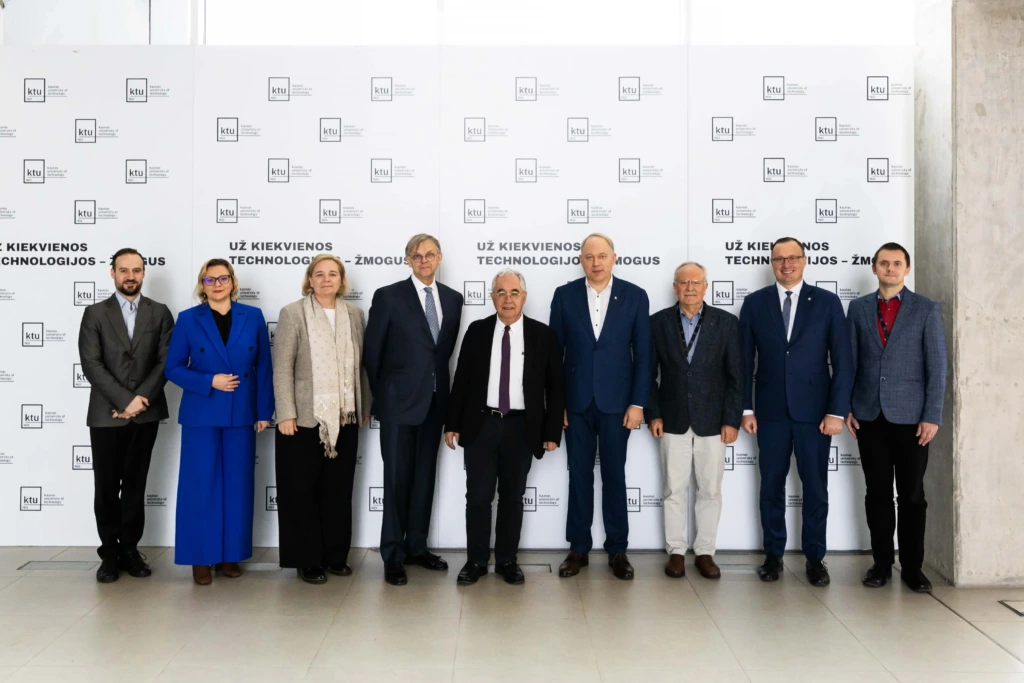
A group of people officially dresses at the KTU photo wall
CERN Council President's visit to KTU

According to the KTU Rector, it is important for Lithuania not only to give early-career researchers opportunities to gain experience at CERN, but also to ensure that this experience translates into new expertise, research areas and technological solutions at home. International cooperation should strengthen the local ecosystem rather than serve merely as a channel for talent to move abroad.

“We need to ask not only what CERN can offer Lithuania, but also what Lithuania can offer CERN. The most important thing is to invest in people, especially early-career researchers. CERN gives scientists and engineers the opportunity to work with technologies that often cannot be found elsewhere in the world. Our goal should not simply be to send talent to CERN, but also to create conditions in which the knowledge, experience and international connections they gain strengthen Lithuania’s science and innovation ecosystem,” says Abakevičienė.

Although CERN has achieved major scientific breakthroughs, including the discovery of the Higgs boson, many fundamental questions in physics remain unanswered. Asked which future scientific or technological breakthrough he is personally most looking forward to, Fountas singles out the FCC project.

“Although we have discovered the Higgs boson, many questions remain unanswered, and the project could also bring technological advances. That is why the FCC is at the top of my list of interests. I believe it is Europe’s future,” says the CERN Council President.