By replacing Portland cement in the mixture, one can get geopolymer mortar or concrete that can substitute conventional cement‑based materials in construction.
Less Prone to Heat Damage than Conventional Concrete
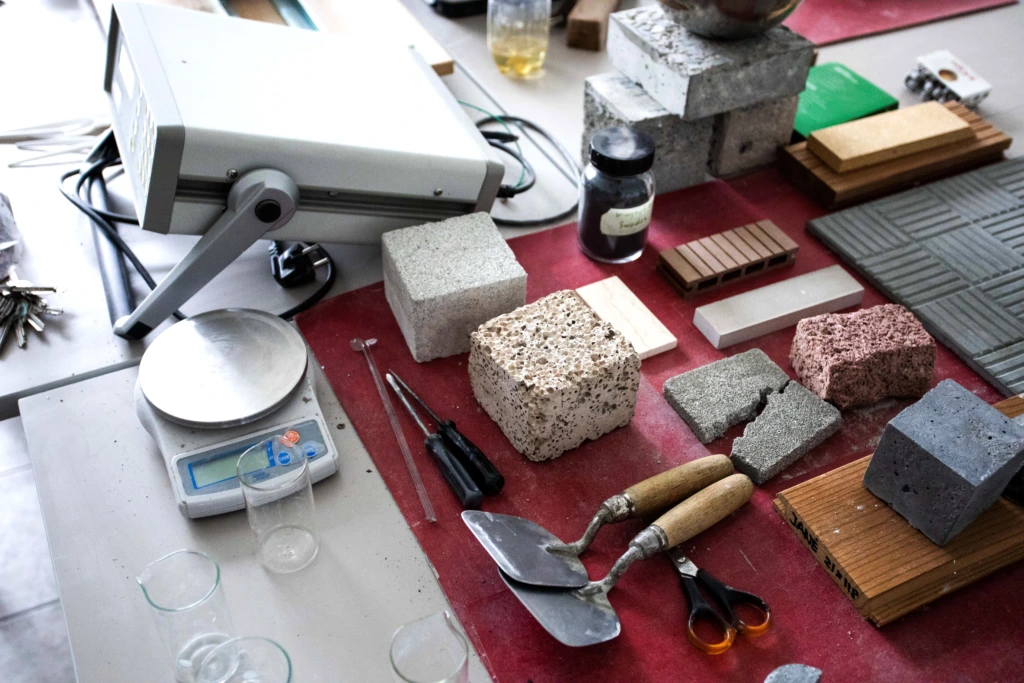
Prof. Vaičiukynienė’s research group has been analysing waste-based geopolymer binders for years. In their recent study, the scientists used ceramic brick and metakaolin waste as precursors and five different fine aggregates – sand, granite, basalt, ceramic waste and corundum – with surprising results.
At 800°C, the best-performing mixes reached 34.7 MPa and 53.0 MPa strength, with only limited microcracking. In comparison, conventional Portland‑cement concretes typically suffer severe strength loss and damage at similar temperatures, making these waste‑based geopolymers a far more robust option for fire‑exposed structures.
“In buildings and industrial plants, there are zones where concrete quite literally works “right next to the fire” – around chimneys, boilers, fireplaces, tunnels or high‑temperature equipment. In those places we need materials that not only do not burn but also retain their strength after exposure to extreme heat, and that is exactly what these geopolymer mortars are designed to do,” explains Prof. Vaičiukynienė.
Typical applications of fire-resistant construction materials include lining tunnels and underground infrastructure, floors, plinths, and protective linings near furnaces, boilers, chimneys, incinerators, or chemical reactors; they are used in passive fire protection systems to act as a thermal shield and protect the integrity of structures.
The study is one of the first to systematically compare several different fine aggregates within the same waste‑based geopolymer system under identical high‑temperature exposure, clearly showing that corundum and ceramic waste aggregates offer the best strength retention after 800°C.
Geopolymer Binder Made Entirely from Waste
According to the KTU researcher, the uniqueness of the material lies not only in its chemical composition and proportions, but also in its dynamic qualities. “We are continuing to work on exploring all of its properties, and we can already see that repeated exposure to high temperatures does not make our mortar weaker – it actually becomes stronger,” reveals Prof. Vaičiukynienė.
Besides strength and durability, she highlights the environmental friendliness of the material as one of its main advantages. The new geopolymer binder is made entirely from waste. For its production, ceramic brick waste was sorted from demolition sites and milled; and metakaolin used in the production was a kaolin waste from a glass factory, situated in Lithuania.
“The metakaolin made a perfect starting base; there’s no need to mill it or sort it, just take it and use it,” explains Prof. Vaičiukynienė. Geopolymer binder, differently from Portland cement, is activated by alkali, without using excessive temperatures. This is another aspect that makes it more friendly to the environment.
Having a background in chemistry, Prof. Vaičiukynienė has been working on the topic of waste-based geopolymer binders for many years. Among the waste used in her projects were phosphogypsum and reed stalks. “When a company approaches with an inquiry about a possible use of their waste material, it’s difficult to figure it out at once. Sometimes, an answer comes after two or three years of continuous experimentation,” she says.
The Adoption in Real-World Construction Projects Is Slow
Although there are many research groups in Europe and beyond working on the topic of geopolymer binders, the world is still slow to adopt these materials in construction – the KTU researcher indicated that she only knows of built structures in Ukraine so far. She believes that one major reason geopolymers are not yet used widely in construction is that there are no clear standards or regulations for that.
“Also, there are psychological and economic barriers: the clinker‑based binder industry has an established market and is understandably reluctant to make room for a new material that could threaten its profits, while concrete producers are wary of working with something unfamiliar that might fail and expose them to legal and financial risks,” says Prof. Vaičiukynienė.
On top of that, she believes that there is still not enough political or regulatory pressure to switch to more environmentally friendly binders, so without standards and incentives, companies have little reason to move away from traditional cement.
The KTU researchers continue testing the fire-resistant geopolymer mortar performance in different conditions, aiming to file a European patent application for their invention.
The above-described study is published in Nature Scientific Reports and can be accessed here.