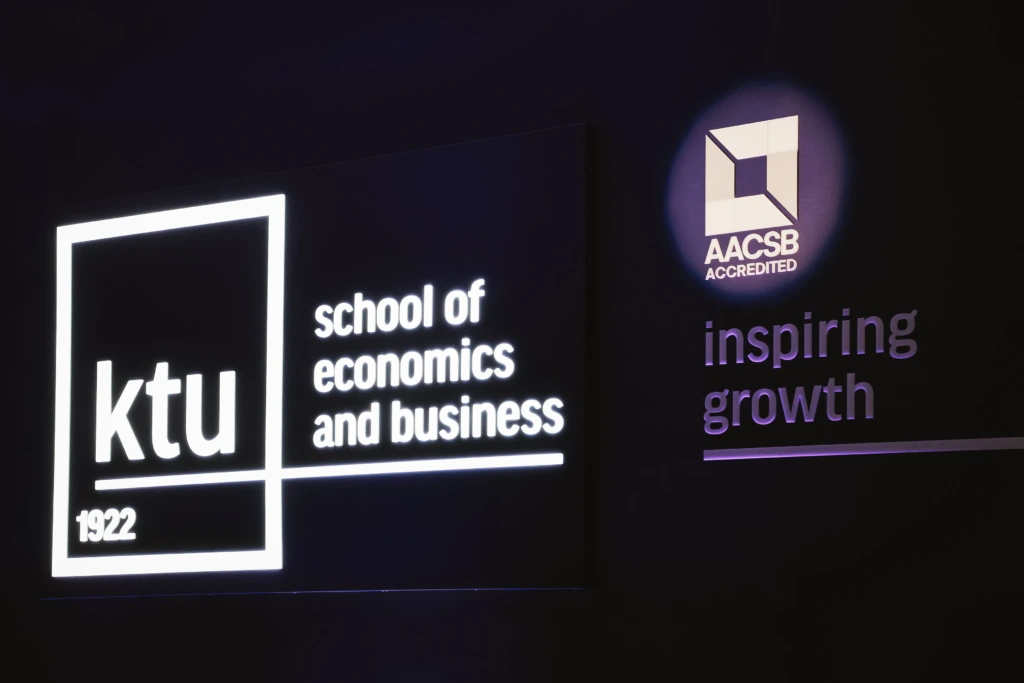
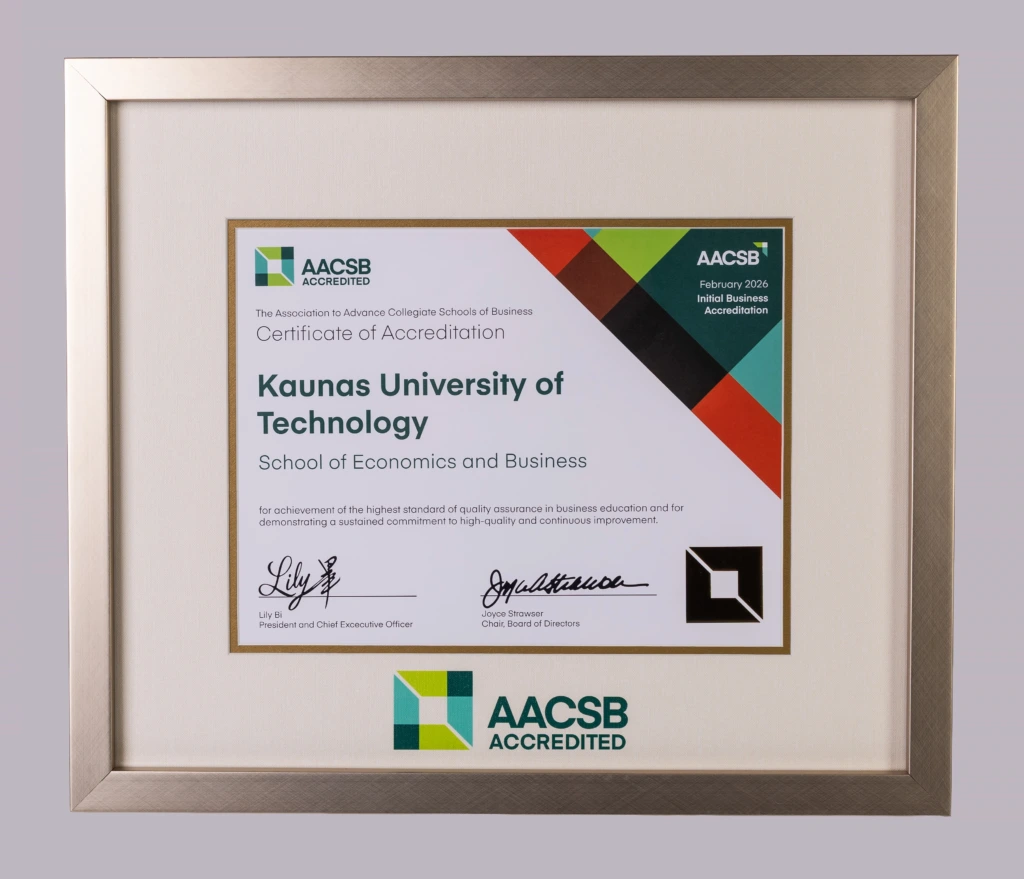
On 6 May, the Kaunas University of Technology School of Economics and Business (KTU SEB) hosted an international event celebrating the significance of AACSB accreditation in contemporary business education. The event brought together distinguished members of the academic community and leading business experts from Lithuania and beyond to explore the value of this globally recognised standard. The gathering culminated in a formal ceremony unveiling a commemorative plaque honouring this prestigious achievement, awarded to KTU SEB earlier this year in the United States.
This confirms that KTU creates an excellent environment for study, research and business collaboration that meets the highest global standards. According to the Rector, achievements like this perfectly reflect the University’s values – unity, professionalism, responsibility and innovation – which are evident in the daily work of our community.
“I sincerely congratulate the faculty team, students, alumni and partners – this achievement belongs to everyone who contributes to KTU’s progress every day. Behind this recognition lies a great deal of daily work, focus and community effort, of which we can be truly proud,” said Prof. Valatka
The discussion held at the KTU School of Economics and Business was moderated by Prof. Dr Jurgita Sekliuckienė, Head of the School’s AACSB (Association to Advance Collegiate Schools of Business) Accreditation Project. The discussion was attended by Prof. Dr Hanna-Leena Pesonen, Dean of the Faculty of Economics and Business at the University of Jyväskylä (Finland), a long-standing AACSB evaluation expert who contributed to KTU’s accreditation processes, Dr Katalin Kovacs, Head of International Development at Peregrine Global Services (and former Dean of International Study Programmes at Maastricht School of Management in the Netherlands), and Assoc. Prof. Dr Kristina Ukvalbergienė, Vice-Rector for Studies at KTU.
Following the discussion, event participants were invited to a formal ceremony to unveil the AACSB accreditation plaque.
Accreditation Process As Catalyst for Change
During the discussion, Assoc. Prof. Dr Ukvalbergienė noted that the pursuit of AACSB accreditation had become a significant process, driving changes in the quality of studies and the learning environment. According to the Vice-Rector for Studies at KTU, to meet international quality standards and rapidly changing external demands, KTU School of Economics and Business is consistently developing a competence-based study model and the principles of modular master’s programmes.
“The accreditation process at KTU has become a significant catalyst not only for updating the content of studies, but also for a much broader transformation of the study process. This has prompted us to take a fresh look at how we design the learning process, how we assess academic achievements, and how we shape the students’ overall experience at the University. We aim for studies to be deeply engaging and to provide an experience that nurtures the individual, broadens thinking, and empowers students to create new value in the world of the future,” said Assoc. Prof. Dr Ukvalbergienė.
Sharing her experience, she emphasised that the greatest value of accreditation lies not only in the final assessment or international recognition, but also in the process itself.
The Multifaceted Benefits of Accreditation
The value of AACSB accreditation manifests itself differently for various stakeholders. For students, it means the opportunity to study at a world-class institution, develop sought-after skills, discover their professional path and become agents of change. Such schools produce graduates who excel in the job market, can solve complex problems and create value within organisations and society.
Meanwhile, on a broader scale – for countries and regions – AACSB helps to ensure high-quality business education, which directly contributes to a country’s economic growth, innovation and social welfare.
Dr Katalin Kovacs, who took part in the discussion, highlighted the transformative impact of the AACSB accreditation process on higher education institutions. This process not only helps to ensure the quality of studies but also strengthens the institution’s commitment to creating a meaningful impact both within the university and beyond – for the wider community and the region.
“The AACSB principles encourage the continuous improvement of study programmes, a focus on developing students’ competencies, and the creation of long-term value for the academic community and the region,” noted Dr Kovacs.