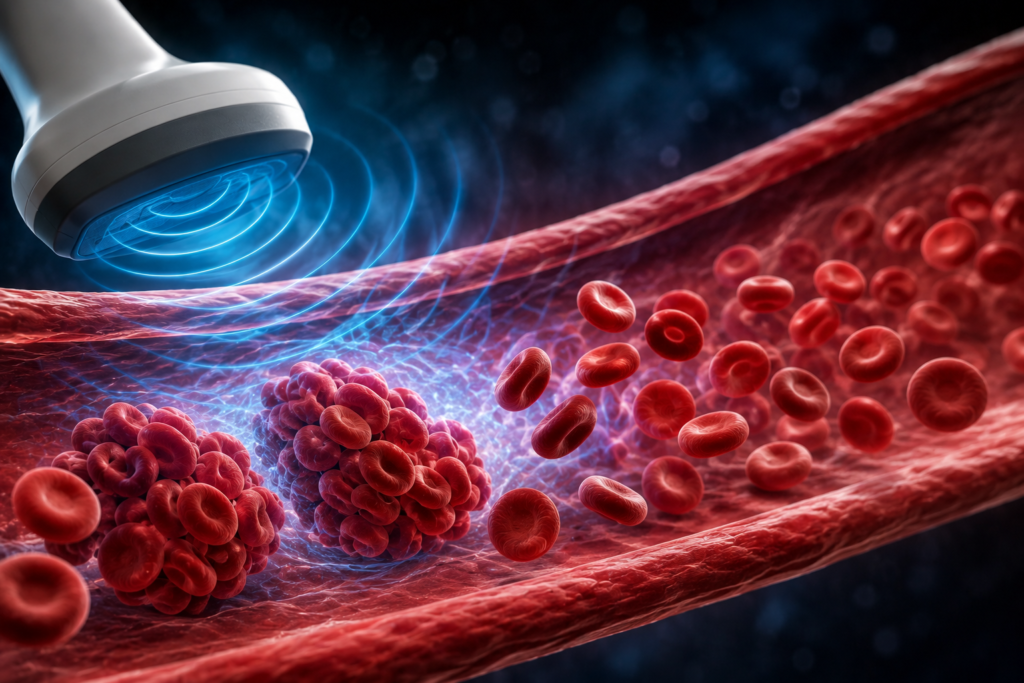
Low-frequency ultrasound, however, generates travelling acoustic waves that create shear forces capable of separating aggregated erythrocytes into single cells.
The experiments demonstrated that low-frequency ultrasound can dissociate erythrocyte aggregates into single cells. “To our knowledge, this effect has not previously been demonstrated,” says Ostaševičius, director of the KTU Institute of Mechatronics.
When erythrocytes separate, gaps appear between them, which decrease blood viscosity, and the entire surface of the cell can participate in oxygen exchange.
The idea for the research emerged during the COVID-19 pandemic, when scientists searched for non-invasive ways to support patients experiencing severe respiratory complications.
“At the time, there was an urgent need for therapies that could help patients quickly and without medication. We became interested in whether ultrasound could intensify the interaction between haemoglobin and oxygen in the lungs,” says Ostaševičius.
To investigate this, the team divided the patients’ blood into several hundred samples, which were exposed to ultrasound of varying intensities and revealed the peculiarities of erythrocyte dissociation. While studying ultrasound propagation in biological tissues, the team used digital twins to develop a low-frequency ultrasound transducer capable of sending acoustic signals approximately four times deeper into biological tissues than conventional devices. This technology is now protected by an international patent.
Potential Applications in Alzheimer’s Disease and Diabetes Treatment
Although the technology remains at an early research stage, the researchers believe low-frequency ultrasound could eventually be applied in several medical fields where blood circulation and oxygen delivery play an important role.
One of the areas being explored is cancer therapy. Since tumour tissue is often mechanically weaker than surrounding healthy tissue, travelling acoustic waves are being explored as a way that may help selectively affect tumour structures. However, this concept is still at an early research stage.
“Low oxygen levels in tumours remain one of the major challenges in cancer therapy. If oxygen delivery to tissues can be improved locally, it may help increase the effectiveness of certain treatments,” says Ostaševičius.
The researchers also see potential in Alzheimer’s disease therapy, where the approach is being discussed as a potential future way to temporarily open the blood-brain barrier and, in future, improve targeted drug delivery to brain tissue.
According to Prof. Ostaševičius, the technology could also support the treatment of diabetic foot ulcers, where impaired circulation makes wound healing significantly more difficult. “Using ultrasound, it may be possible to improve blood flow in affected tissues,” he says.
Additional future applications may include targeted drug delivery and supportive therapies for cardiovascular and pulmonary diseases.
Although the technology is still experimental, the researchers believe their findings broaden the understanding of ultrasound as more than a diagnostic tool. “Our work shows that ultrasound can mechanically influence blood properties. This opens possibilities for future non-invasive therapies that may one day complement existing medication-based and surgical treatments,” says Ostaševičius.
The article “Advances in Ultrasonic Rehabilitation” can be accessed here.