

Skip to content
Mustard yellow background with a white bowl and three rising steam lines, and the text “2 Zero Hunger.” Represents the goal to end hunger and achieve food security.
Green background with a white heart and an electrocardiogram line, next to the text “3 Good Health and Well-Being.” Highlights the importance of ensuring healthy lives and well-being
Magenta background with a white icon of four arrows pointing outward from an equals sign, and the text “10 Reduced Inequalities.” Represents the goal of reducing inequality within and among countries.

Kaunas Student Guide: Life Hacks for Eating Well and Spending Less

Important | 2026-08-06

Figuring out where to shop and how to eat well without stretching your student budget often takes some trial and error when arriving in a new country. To help you settle in faster, we asked KTU international students to share practical tips they have discovered, along with a few lesser-known life hacks.

By making use of Kaunas’ compact layout, exploring the range of supermarkets, and timing your shopping around discounts, it is entirely possible to build a comfortable routine, eat well, and stay within budget. The city offers a high quality of life without forcing students to compromise, making it easy to enjoy everything it has to offer.

Navigating Kaunas Supermarkets

Lithuania has a modern retail environment, with large hypermarkets and well-established chains such as Maxima, Rimi, Lidl, IKI and others, all offering a wide selection of everyday and speciality goods. Kaunas itself is a compact, human-scale city, which makes grocery shopping especially convenient.

Students quickly develop their own preferences. For many, accessibility and pricing play a key role. As Aleksandre Edisherashvili, a second-year New Media Language student from Georgia, explains: “Reaching different parts of the city has been reliable and convenient for me so far, and I feel like I can reach my preferred restaurants or shops and just get around really easily. My go-to shopping place in general is Lidl.”

Rather than relying on a single store, many students mix and match depending on their needs. Smaller shops are common in central areas like Old Town, Laisvės Alėja, and Žaliakalnis, while larger supermarkets on the outskirts offer a broader selection, still accessible by a short bus ride.

Price sensitivity also shapes these habits. Oluwalana Isaac Ayomikun, a second-year Electronics and Electrical Engineering student from Nigeria, notes that comparing prices early on helped him define his routine: “I use Maxima or IKI most of the time and once in a while Lidl. Maxima is the cheapest, IKI is convenient when I do not want to go far, although it is more expensive, and Lidl is better for groceries.”

For others, variety and reliability matter just as much as price. Arailym Abilova, a Public Governance student from Kazakhstan, highlights that larger supermarkets usually cover all essential needs: “I can usually find everything I need in the larger supermarkets in Kaunas, so I have not had much difficulty finding ingredients that suit my preferences.”

Oluwalana Isaac Ayomikun

Saving Tips for Grocery Shopping in Kaunas

Lidl is a favourite among students looking to reduce everyday expenses. Choosing own-brand products such as milk, sour cream, cheese, and dry goods is a simple way to maintain quality while lowering costs.

Shopping strategically within larger stores can also make a noticeable difference. Lidl offers a dedicated protein dairy section with affordable options such as protein milk, yoghurt, and low-calorie desserts. Meanwhile, larger Maxima locations feature hot food and deli counters, where you can buy freshly prepared meals by weight and pay only for what you need.

Another essential saving tool is the use of loyalty programmes. Arailym emphasises their practicality: “All supermarkets have loyalty cards and often offer good discounts, so they are convenient for students. I would definitely recommend getting a loyalty card to save money on everyday shopping.”

There is no need to visit stores in person to sign up. Each chain provides a mobile app where you can register and scan your digital card at checkout, ensuring consistent access to discounts.

A Late-Evening Bakery Hack

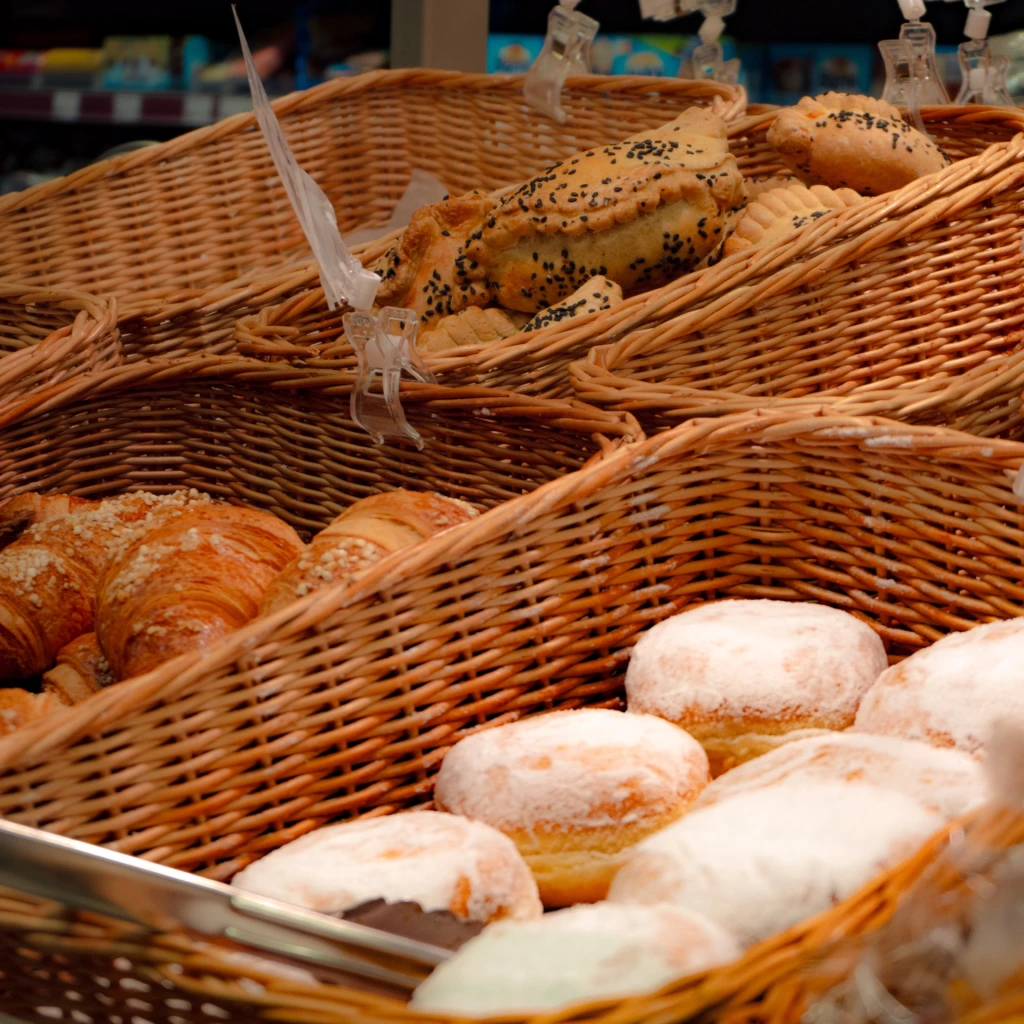
Pastries photo by Bora Yeniay

For students studying late, Lithuanian supermarkets offer an unexpectedly useful advantage. Bakery sections (kepyklos gaminiai in Lithuanian) continuously produce fresh goods throughout the day, and in the evening, many of these items are discounted.

After around 7–8 PM, it is common to find bakery products marked down by up to 50 per cent. This makes it an ideal time to pick up fresh rolls, pastries, or snacks after a long study session.

Aleksandre notes that this system can also contribute to reducing food waste: “I really like that system.

Even if some items are less fresh later in the day, I have always had a good experience. We save money while also playing a small role in reducing food waste.”

It is also a practical dinner solution. Discounted pizzas, buns, or kibinai – traditional savoury pastries – can be both affordable and filling during busy weeks.

Bonus Tip: Finding a Taste of Home

Adjusting to a new food culture can take time, but Kaunas offers increasing access to international ingredients. Larger supermarkets include dedicated international sections, and specialised shops continue to appear across the city.

Isaac shares a pragmatic approach: he occasionally visits speciality stores such as Afroman Shop, though he notes they can be more expensive. Instead, he often brings spices from home or asks friends to bring them when travelling, while relying on local supermarkets for everyday alternatives.

Several specialised stores in Kaunas are worth exploring:

Flexibility is often key. As Aleksandre explains, some traditional dishes are easy to recreate with local ingredients, while others require adaptation or are best enjoyed in local restaurants offering authentic cuisine.

Day Lunch: A Lithuanian Classic

Kaunas has a diverse and affordable dining scene, and one of the most useful local traditions for students is dienos pietūs (daily lunch offers).

Laisvės Alėja, one of the longest pedestrian streets in Eastern Europe, is lined with cafés and restaurants where these offers are widely available. Typically served on weekdays from around 11 AM to 3 PM, they provide a cost-effective way to eat out.

Aleksandre highlights both variety and affordability: “I like to try the soup of the day whenever I go to a restaurant, and these offers are great because affordability is very important for students.”

For around €8, you can often get a multi-course meal or a generous main dish, ranging from traditional soups like šaltibarščiai to salads, pasta, or vegetarian options.

Arailym adds that personal favourites still matter: “I simply go to restaurants that I enjoy. My favourite places in Kaunas are Sushi Lounge and Chačapuri.”

Fast Food and Delivery Tips

“I’m not a picky eater, but my favourites are the kebab spots around Kaunas, where I can get a full meal at a cheaper price,” says Umme Aimon, a former student in Energy Technologies and Economics and a Student Ambassador at KTU, from Bangladesh.

Hesburger is another popular choice. Its mobile app provides rotating weekly deals, sometimes reducing the price of a full meal to around €4. Additionally, presenting an ISIC student card can give a 10% discount on regular menu items.

Umme Aimon
Umme Aimon

Delivery platforms such as Bolt Food and Wolt are widely used in Kaunas due to their convenience and variety.

Isaac notes that Bolt Food is his preferred option for ordering in. However, timing matters: prices often increase after 6 PM due to peak demand, so ordering earlier can help reduce costs.

Sharing meals is another effective strategy. Many pizza chains offer “buy one, get one free” deals, making group orders significantly more economical.

Finally, if a restaurant is nearby, ordering directly and picking up the food yourself can sometimes be cheaper than using delivery apps, as menu prices on these platforms may include additional markups.

Text and photos by Bora Yeniay