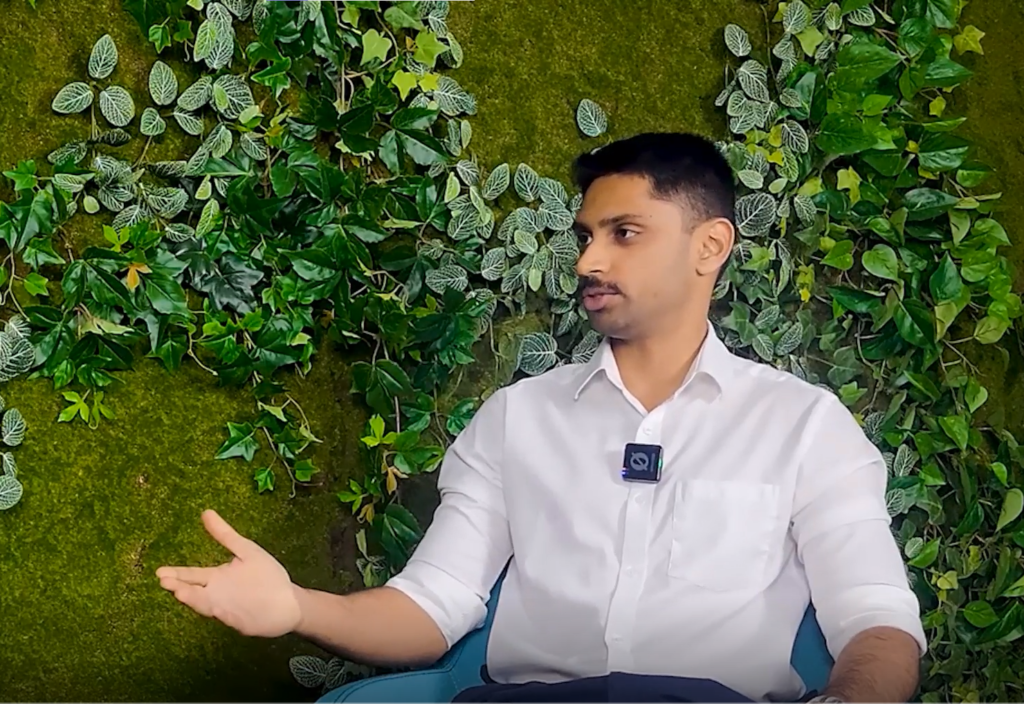




Neither Lithuania nor studying linguistics were part of Ronald Christopher Rosario’s original plans. While his father hoped he would pursue engineering in Europe, Ronald himself was drawn to applied or nuclear physics. Yet, a few unexpected turns brought the young man from India to Kaunas University of Technology (KTU), where he eventually graduated in New Media Language and even found reasons to stay in Lithuania after his studies.
Today, Lithuanian is even making its way into his home. Ronald and his Lithuanian partner have a daily agreement to speak only Lithuanian for an hour, šaltibarščiai have become a summer favourite, and šakotis travels with him as a souvenir when he visits relatives abroad. He has even discovered surprising similarities between Lithuanian and his native language Tamil.
A Programme He Did Not Plan to Choose
Coming to Europe was partly a family decision. Like many young people in India, Ronald was encouraged to choose a career path considered practical and reliable – engineering. His own interests, however, were taking him in a different direction.
“Going to Europe to study engineering was especially my dad’s choice, which is quite typical in many Indian households. Although I didn’t really want to study mechanical engineering, I was interested in something closer to applied or nuclear physics,” says Ronald.
Lithuania was not among the countries he initially considered either. His shortlist included the UK, Germany and the Czech Republic, but his cousin, who was already studying in Kaunas, encouraged him to consider Lithuania. She described the country as cold and quiet – qualities that did not discourage Ronald, who liked the idea of peaceful surroundings, nature and a real winter.
His study plans changed after arriving in Kaunas. After two semesters, Ronald heard from friends about New Media Language, a programme quite different from what he had originally imagined studying.
“I did two semesters, and then I had a couple of friends talk about this new programme in the KTU Faculty of Social Sciences, Arts and Humanities, New Media Language. It was more about linguistics, about learning languages, which fascinated me. So, I decided to change my subject,” he recalls.
Found Similarities Between the Lithuanian and Tamil Languages
After graduation, Ronald moved into sales and now works as an Account Executive at Nexus.ai. Although he had considered moving to Germany or the UK and spent an Erasmus semester in Brno, Czechia, the life he had built in Lithuania eventually convinced him to stay. His career, quality of life and close friendships all played a part in that decision.
His years in Lithuania also changed his perception of Lithuanians. Ronald disagrees with the common stereotype that they are cold or distant.
“Lithuanians are very warm in that sense that they genuinely care; if you went up to them and said, hey, I’m having this problem, they would think of ways to help you. And that’s the contrast to what most people think about Lithuanians. They just don’t want to spend their energy on someone that does not need it,” explains the KTU alumnus.
Ronald has also adopted some local habits himself. Encouraged by his Lithuanian partner, he has learned to appreciate straightforwardness and to speak more openly when something bothers him. Lithuanian has become part of their daily life too – the couple spends an hour each day speaking only Lithuanian, even though Ronald admits that expressing his emotions in a foreign language can still be challenging.
Learning the language has also revealed an unexpected connection with his native Tamil. “I found it very interesting that it’s similar to my mother tongue, Tamil. It is like literally the same word with a different ending, padam and padas, which means the sole,” notes Ronald.
Hear first-hand from KTU international students – watch their podcasts and discover their stories.