



Skip to content
Green background with a white heart and an electrocardiogram line, next to the text “3 Good Health and Well-Being.” Highlights the importance of ensuring healthy lives and well-being
Dark red background with a white open book and pencil icon, alongside the text “4 Quality Education.” Represents the goal of inclusive, equitable, and quality education for all.
Mustard background with a white infinity loop featuring a curved arrow, and the text “12 Responsible Consumption and Production.” Symbolizes sustainable consumption and production patterns.

KTU scientist on the chemistry of the festive table: the whole truth about herring bones

Important | 2025-12-22

If you have taken part in at least one traditional Christmas Eve supper in Lithuania, you know that it is all about herring (mainly). Herring with fried carrots, herring with dried forest mushrooms, herring on bread, and herring on potatoes – out of 12 meals on the table, at least half have herring in them.

This fish is rich in omega-3 fatty acids and has long been a staple of the diets of people in the Baltic and Scandinavian countries. Even more valuable than tuna or salmon in this respect, herring is loved by Lithuanians not only for its taste, but also for how easy it is to prepare.

Aelita Zabulionė, Head of the Sensory Analysis Research Laboratory at Kaunas University of Technology (KTU), says that herring is a versatile fish with endless possibilities for processing and preparation, so it is no surprise that demand for it is particularly high during the festive season.

Although removing herring bones may seem like an art form to the inexperienced cook, a KTU researcher is convinced that anyone can achieve this task with a little knowledge of kitchen chemistry.

Natural way to remove herring bones

Do not worry – you will not need expensive chemicals to remove herring bones! The KTU researcher reveals that to optimise the processing of this fish, most of the larger bones are removed when filleting, and the remaining small bones can be softened using vinegar or citric acid. Although the acid does not completely dissolve the bones, they are softened enough to be edible, and there is no need to worry about them getting stuck in your throat.

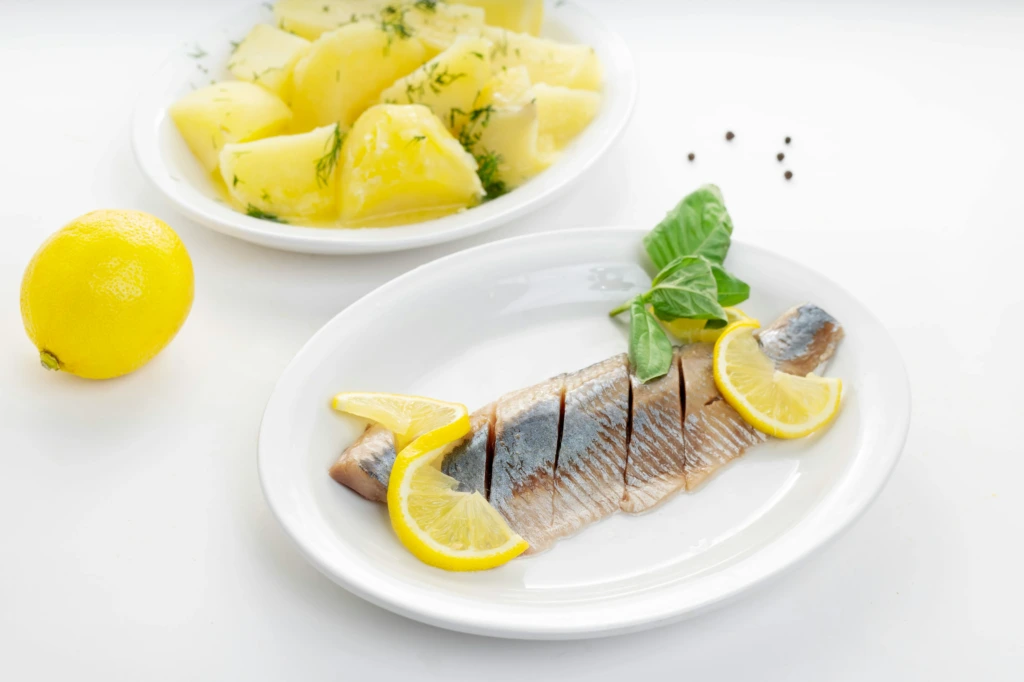
“If you try to fillet a herring, you will notice that its bones are soft and thin, like hair, rather than hard and rigid. Herring bones are made up of similar components to human bones – they are mostly calcium, carbonates, and phosphates. The chemistry here is simple: these components are dissolved by acid,” explains Zabulionė.

According to the scientist, using lemon juice makes it easier to balance the taste of the dish: “Vinegar has an intense sourness, so you have to use a lot of salt and sugar to prevent the marinade from being too sour. It’s easier to do this with citric acid.”

Aelita Zabulionė
Aelita Zabulionė, Head of the KTU Sensory Analysis Research Laboratory

Chemistry – in every breath we take

Zabulionė is convinced that knowledge of chemistry is relevant to everyone – this science allows us to better understand the world around us and its processes.

“I always say that there is chemistry in every breath we take,” says the scientist.

Knowledge of chemistry can help when preparing the Christmas Eve table by ensuring that pre-prepared dishes are stored in the right conditions and do not spoil, thereby preventing food poisoning or infection during the holidays. The expert encourages people to consider carefully whether the prepared food will actually be eaten.

“Although prepared food can be frozen to extend its shelf life, freezing does not stop food from spoiling; it only slows down the process. Therefore, food should be frozen as soon as possible, without waiting for the smell or taste to become suspicious. Also, products should not be kept in the freezer for too long – I would not recommend keeping cooked food in it for more than 2-3 months,” says Zabulionė.

The KTU researcher notes that with the rapid development of the food industry, society does not always trust innovations – there are too many myths and too little easily readable, understandable information, which is why some simple processes become mystified.

“That is why the KTU Food Institute is organising various initiatives to increase understanding of everyday food, the chemical processes involved in it, and hygiene requirements when cooking at home,” says Zabulionė.