The University aims to consistently increase the economic, environmental, social, and cultural impact of its research and art activities by focusing its efforts on priority areas aligned with the country’s smart specialisation priorities. The competence and international visibility of researchers are strategically strengthened, cooperation networks expanded, and conditions created for the development of high-value-added knowledge, thus contributing to the progress and competitiveness of the state. Centres of competence and excellence are developed through consistent coordination of their activities, the implementation of open science policy, and greater public involvement in research and art activities. Strengthening researchers’ initiative, strategic thinking, leadership, and entrepreneurship will ensure the effective integration of new knowledge, technologies, and solutions into the R&D&I ecosystem. This will encourage closer cooperation with partners in industry, business, science, and the public sector, strengthen the relevance of research, and reinforce its practical value for society.
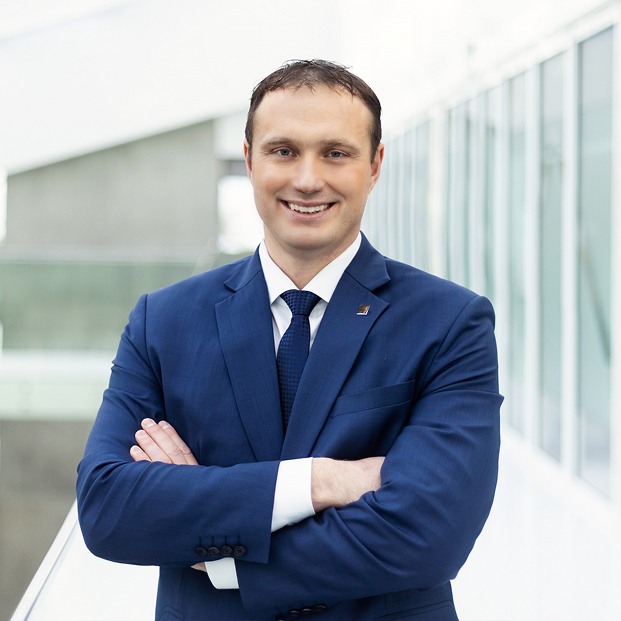
Strategic direction Research and Development for Technological Progress aims to increase the impact of research and art activities on society and the economy. This will be achieved by pooling resources in key areas, strengthening researchers’ capabilities and international recognition, and expanding partnerships to create innovative solutions and knowledge that contribute to the country’s progress and competitiveness.
Prof. Dr. Kęstutis Baltakys
Vice-Rector for Research
By implementing the priorities of this strategic direction, KTU strengthens its research and experimental development potential by advancing priority research areas, international partnerships, research infrastructures, the empowerment of early-stage researchers, and the application of technologies for societal progress.
M1 |
Development of Priority Fields of the Science and the Arts |
1.1. Increase targeted participation in competitive international and national research and innovation funding programmes.
1.2. Coordinate researchers’ participation in international scientific networks and partnerships.
1.3. Strengthen the role of Lithuanian and European research infrastructures and promote the University’s participation in new infrastructure networks.
1.4. Develop R&D&I activities with high-quality impact and practical applicability.
Objective
To promote the development of priority research and art fields through funding attracted from external sources and the effective utilisation of research infrastructure.
M2 |
Targeted Strengthening of Scientific Potential |
2.1. Strengthen the general and subject-specific competencies of early-career researchers.
2.2. Develop doctoral students’ leadership, scientific independence, and innovation development skills.
2.3. Promote the mobility and participation of doctoral students and early-career researchers in international scientific networks.
Objective
To ensure faster integration of doctoral students and early-career researchers into the academic community by strengthening international cooperation, mobility, and opportunities for knowledge sharing.
M3 |
Interdisciplinary Research and Art Knowledge Creation |
3.1. Develop and implement a model for managing research activities and clusters operating in priority areas.
3.2. Consistently plan and coordinate research and art activities.
3.3. Implement the open science policy.
3.4. Organise high-level international scientific events and involve public to participate in research and art processes.
Objective
To create innovative knowledge, technologies, and solutions by developing centres of competence and excellence, and promoting active cooperation with partners across science, business, industry, and the public sector.
M4 |
Transfer of Technologies and Products, and Value Creation |
4.1. Develop knowledge and technology transfer competencies.
4.2. Promote entrepreneurship among researchers by involving them in innovation creation and business development processes.
Objective
To transform new knowledge and technologies into values that benefit society and promote economic progress.

The implementation of initiatives under this strategic direction will strengthen the University’s contribution to national smart specialisation priorities and to the creation of high added value for the state. It will enhance the sustainability of research funding by diversifying funding sources, promoting innovation development, strengthening partnerships with business, industry, the public sector, and research institutions, and improving evaluation results of the quality of R&D activities.
The development and implementation of a career pathway model for early-career researchers will enable doctoral students to acquire the competencies required for an academic career, increase the number of dissertations defended on time and the number of third-cycle fellowships, and accelerate the integration of doctoral students and early-career researchers into the academic community.
The effective operation of competence and excellence centres will increase the number of researchers and the volume of external funding attracted. Improved research results’ quality and active networking will strengthen the University’s competitiveness and international recognition. Promoting technology transfer will further enhance the positive impact of research results on the national economy and reinforce the innovation ecosystem.
Vice-Rector for Research
Prof. Dr. Kęstutis Baltakys
K. Donelaičio St. 73, LT-44249 Kaunas
email kestutis.baltakys@ktu.lt