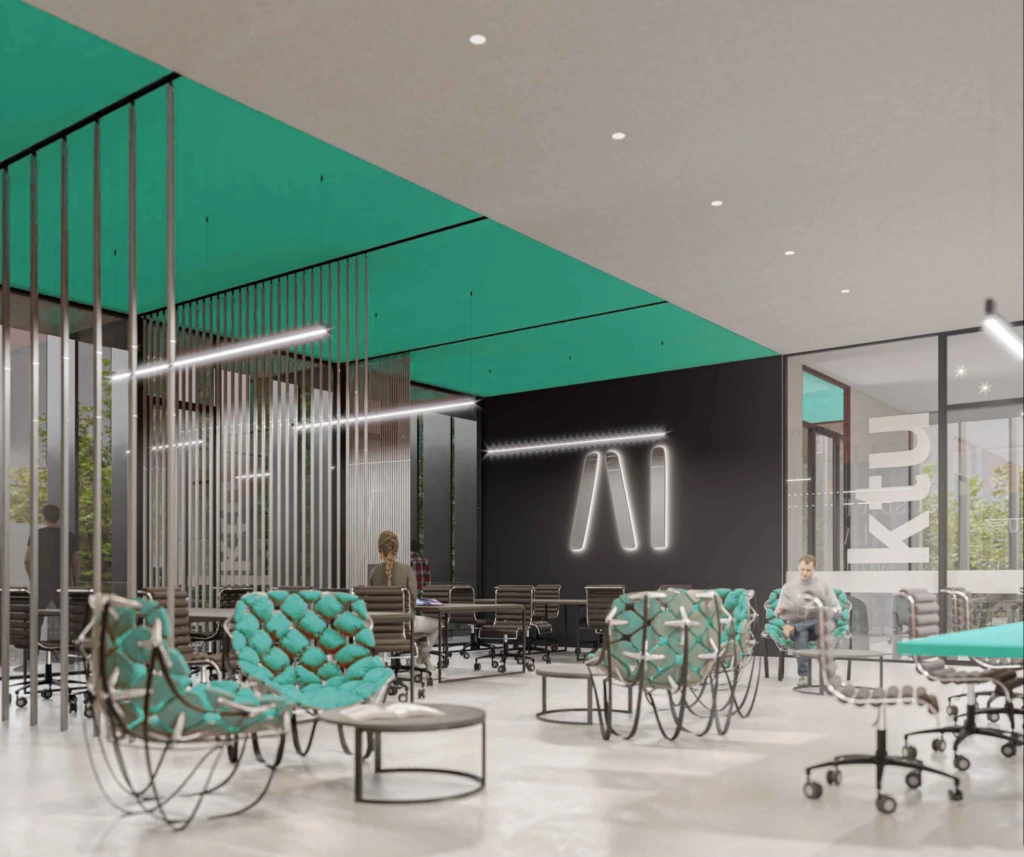
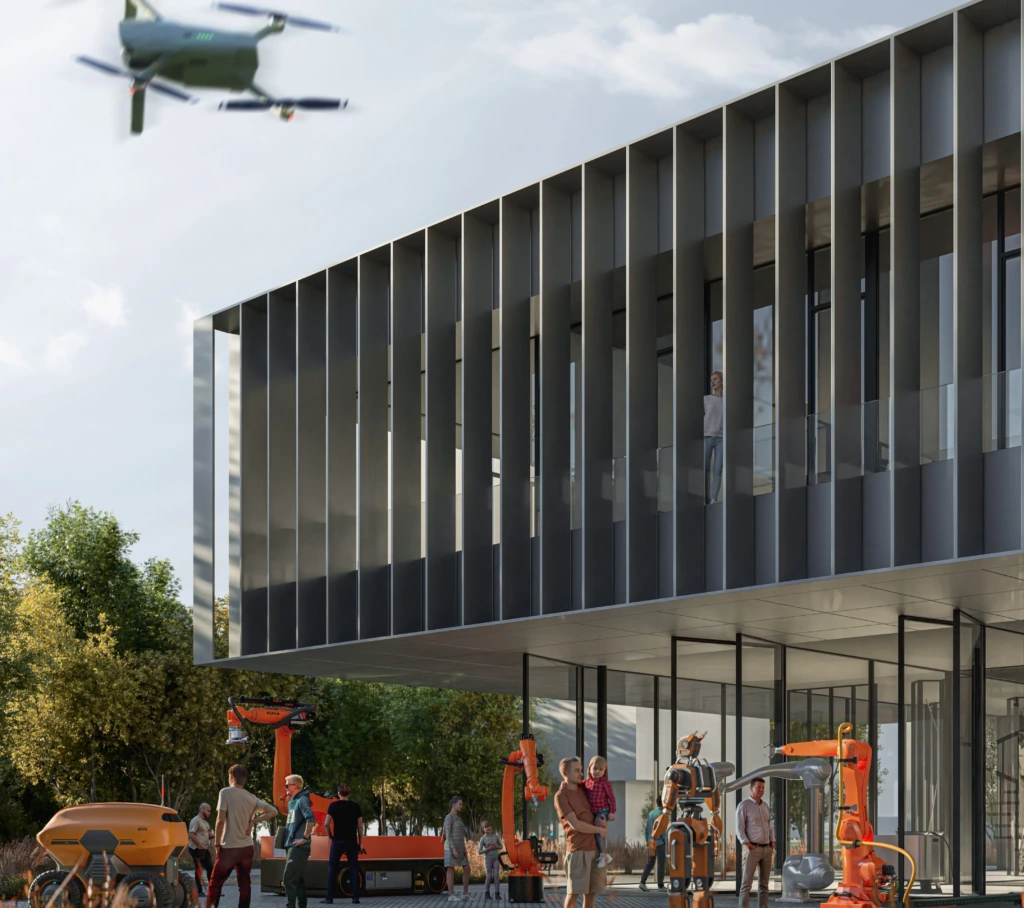
As demand for artificial intelligence (AI) solutions grows across all parts of the economy and the public sector, attention is increasingly focused not only on technological progress but also on the responsible, ethical and sustainable use of AI. In response to these trends, Kaunas University of Technology (KTU) is developing the Centre of Excellence of Artificial Intelligence for Sustainable Living and Working, SustAInLivWork, on its student campus. The centre aims to strengthen the AI research and innovation ecosystem in Lithuania, both nationally and internationally.
The centre is being developed as a long-term investment in advanced technologies that address pressing societal challenges in four priority areas – industry, transport, energy and healthcare.
From research to real-world solutions
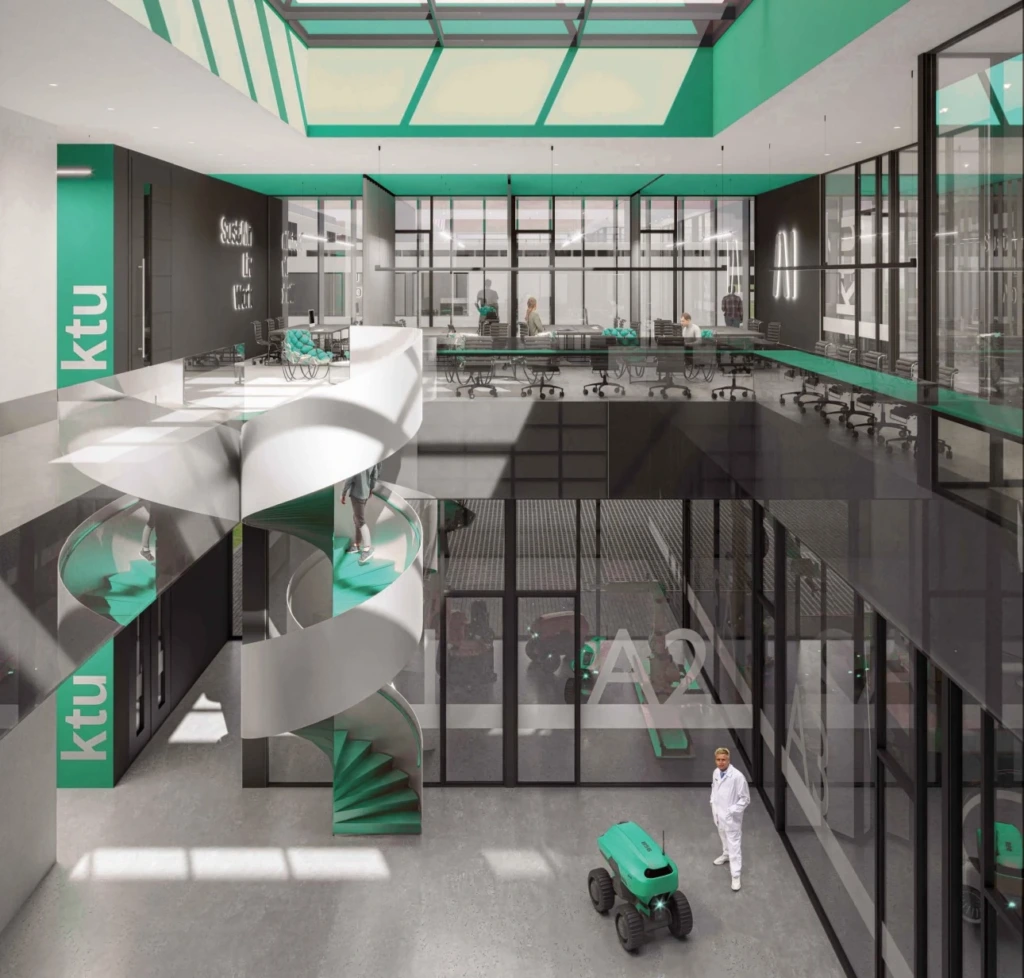
The new centre will support a broad range of activities, from fundamental and applied research to the testing, validation and deployment of AI solutions in real operational environments. It will house smart AI laboratories equipped with high-performance computing (HPC) resources, robotic systems, unmanned aircraft equipment, and electrical grid modelling technology.
Alongside state-of-the-art technological capabilities, the centre will also focus on developing and strengthening AI skills, with particular emphasis on practical training and education. High value-added training programmes will be created – courses, training sessions and hands-on workshops – geared towards the sustainable and responsible development, use and deployment of AI. At the same time, advanced explainable AI (XAI) systems will be developed to ensure transparency, accountability and interpretability of decisions, thereby strengthening trust in AI technologies and their application in practice.
“For business, this will open up not only new opportunities to accelerate innovation – including high-risk AI solutions – and reduce the risks associated with deployment, but also, through close collaboration with researchers, to develop and commercialise patented AI solutions,” says Professor Paulauskaitė-Tarasevičienė.
This partnership will also be strengthened through practical collaboration formats. The centre will organise innovation fairs, hackathons and other events that promote knowledge exchange, technology transfer and the development of new business models.
A distinctive initiative in Lithuania
Dr Vilma Karoblienė, Head of the KTU Research and Innovation Project Centre and National Funding Part Manager of SustAInLivWork, emphasises that the centre stands out in Lithuania not only for its scale, but also for its long-term, value-driven operating model, focused on sustainable impact on the innovation ecosystem at both national and international level. She says that the centre is being developed under the European Union’s framework programme Horizon Europe, through the Teaming for Excellence scheme, and is co-funded by European Union funds.
According to Dr Karoblienė, one of the centre’s objectives is to foster active collaboration in AI between research institutions, business, industry and the public sector. During the project, an AI cluster will be formed as a cooperation platform for different organisations. Such an ecosystem will help attract new international funding opportunities, enable cluster members to develop and implement AI solutions alongside researchers, and strengthen the competitiveness of both the centre and cluster participants in foreign markets.
“We believe this project will provide an exceptional opportunity to strengthen the AI research and innovation ecosystem in Lithuania and internationally. It will also enable collaboration with other AI competence centres across Europe and worldwide. The centre will host annual events bringing together leaders in science and innovation, investors, representatives of business, industry and the public sector, as well as students. We believe these initiatives will give momentum to the growth of new start-ups and to the commercialisation of research outcomes,” says Dr Karoblienė.
International partnership as a guarantee of quality
Alongside international partners – Tampere University (TAU) in Finland and Hamburg University of Technology (TUHH) in Germany – Lithuania’s strongest research institutions are also actively involved, providing a robust national foundation for AI expertise. The project is coordinated by Kaunas University of Technology (KTU), with partners including the Lithuanian University of Health Sciences (LSMU), Vytautas Magnus University (VMU) and Vilnius Gediminas Technical University (VILNIUS TECH).
“This national partnership enables us to bring together diverse scientific disciplines and competences – from engineering, technology and data science to health, social sciences and the humanities – creating an integrated, interdisciplinary AI ecosystem focused on tangible impact for society, business and the public sector,” says Professor Paulauskaitė-Tarasevičienė.
According to Aistė Valentienė, Project Manager at KTU’s Infrastructure Development Office, the building was designed with a strong emphasis on sustainability. The project includes high-quality glazing, natural daylight solutions, heat-recovery ventilation systems, and energy-efficient equipment designed to reduce heat loss.
“At present, construction is at the demolition stage – dismantling works on the old building’s structures are already under way. Later stages will include the installation of load-bearing structures, the formation of façades, interior fit-out works, the installation of engineering systems and landscaping of the surrounding area,” says Valentienė.
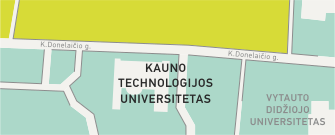
Major refurbishment works at KTU’s premises at Studentų g. 48A in Kaunas began in autumn 2025 and are scheduled to run until the end of 2026.
The SustAInLivWork is co-funded under the European Union’s Horizon Europe programme under Grant Agreement No. 101059903 and under the European Union Funds’ Investments 2021–2027 (project No. 10-042-P-0001).