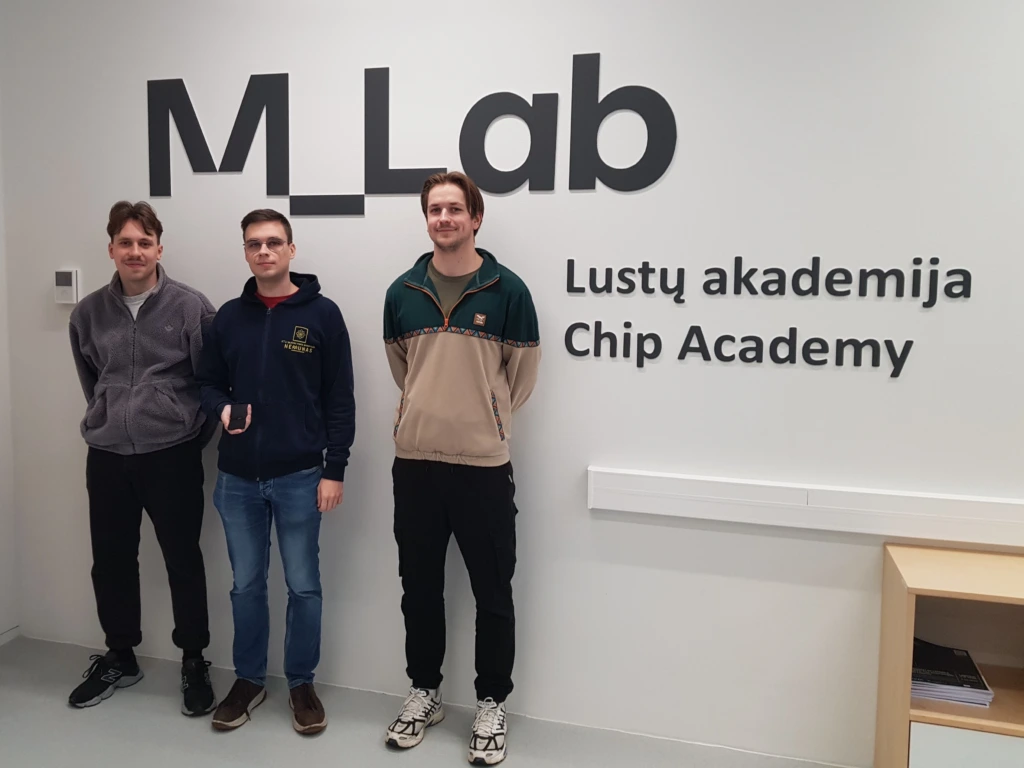
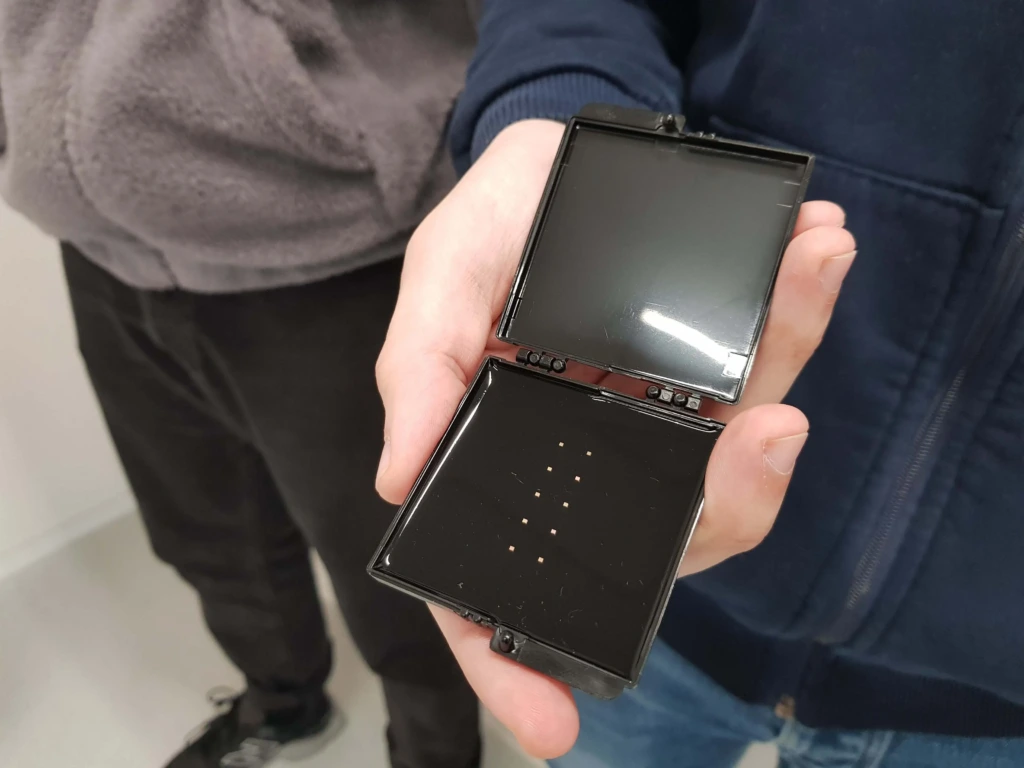
The Chip Academy, which opened this spring at Kaunas University of Technology’s (KTU) interdisciplinary prototyping laboratory centre M-Lab, is reaping its first scientific rewards – students have successfully created a semiconductor system.
KTU master’s students, Aidas Astrauskas, Benas Česnauskas, and Tomas Bakšys, who are immersed in chip design, are delighted with their team’s achievement and are already thinking about future projects.
From idea to implementation
“Chip technology is probably the most complex field in which an engineer can work. This project allowed us to go through the entire design chain – from the scheme to the actual product. We were probably the first in Lithuania to work with these open-source coding tools. Although we didn’t have much time, we quickly learned how to use them, designed the product within a month, sent it to production, and now we already have the result,” say the team members.
The KTU M-Lab infrastructure allows members of the Chip Academy to create chips ranging from the simplest to the most complex, realise them as prototypes, or prepare them for production. Here, students can master different chip design technologies from global market leaders.
“This system can be used not only for testing, but also for real products developed by TiFEC. Due to the level of miniaturisation achieved, it can also be adapted for use in complex systems. This opens up a lot of new possibilities,” says the development team.
To verify the parameters of the chips created by the students, they will continue to be tested at the KTU M-Lab’s prototyping and testing centre, Proto Lab, whose team draws on experience gained not only in Lithuanian but also in international companies.
The entire KTU TiFEC team is not far behind – it is constantly improving its skills through training both in Lithuania and abroad. At the last seminar held at KTU, partners from IHP shared the latest chip design and other technological knowledge.
Young TiFEC researchers recently designed a processor on the RISC-V platform, which has already been sent for production.
New SKILLed Chip Tech programme launched
With the growing demand for semiconductor experts, KTU continues to invest in specialists in the field of chip technology.
In January, the university launched a new Talent Academy programme, SKILLed ChipTech, in which students will be able to acquire the necessary competencies in the field of chip manufacturing and implementation in cooperation with the Chip Academy.
Participants in the specialised programme will not only receive comprehensive training and financial incentives but will also be able to realise their potential by communicating with company representatives, participating in projects, hackathons, training courses, and spending time with like-minded people.
The project “Centre of Excellence in Technological and Physical Sciences (TiFEC)” No. S-A-UEI-23-1 is funded by the Lithuanian Science Council and the Ministry of Education, Science and Sport of the Republic of Lithuania from the state budget under the programme “University Excellence Initiative”.