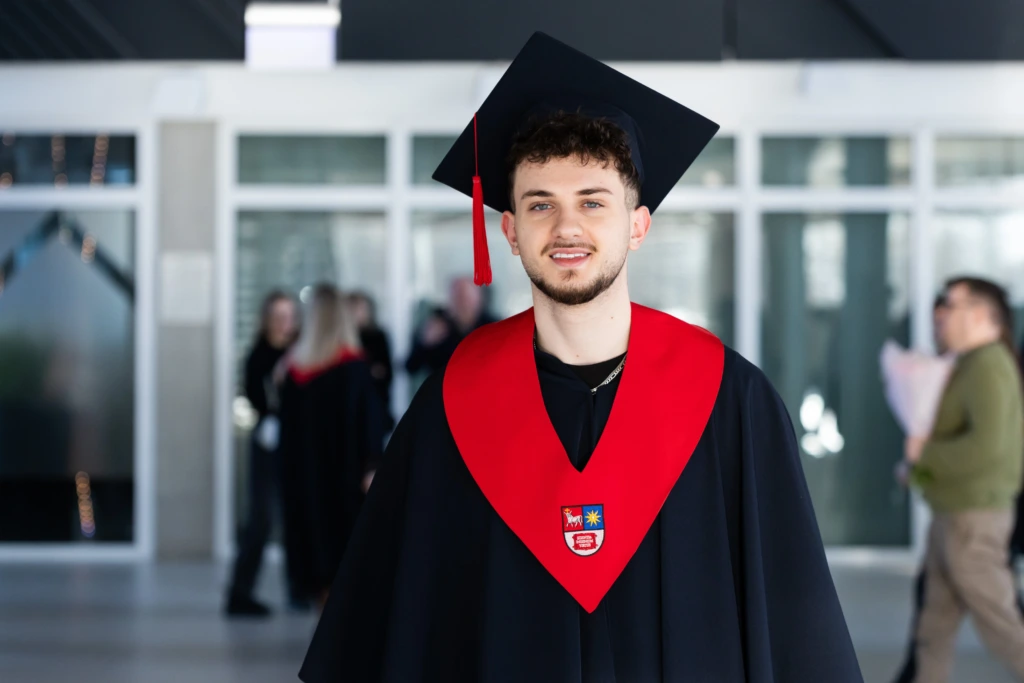



“At first, Kaunas and Lithuania felt quiet and reserved to me, colder both in terms of weather and people compared with what I was used to,” recalls Ahmad Hijazi, a Palestinian who recently finished his master’s in Data Science and Artificial Intelligence at Kaunas University of Technology (KTU).
According to him, the study decision was straightforward: friends recommended Lithuania, and KTU offered the English-taught programme he was looking for. Living in Kaunas, however, turned out to be more difficult than he thought before coming here.
Getting Used to a Colder Place
His first impression of KTU was its structure. The campus was easy to navigate, the international office was responsive, and the study system was clearly organised – which made the first months less overwhelming. Life outside lectures was more difficult: Kaunas offered focus and stability, but it also demanded patience.
“Living in Kaunas has been a mixed experience for me. On the one hand, it gave me space to focus on my studies and build my own routine as an international student in a calm, non-crowded city. On the other hand, it sometimes felt a bit too quiet and distant, especially during the colder months,” he says.
Integration, he notes, did not happen automatically. Like many international students, Ahmad found himself in what he describes as a student bubble – a close circle of people from different countries going through similar transitions. That community made daily life easier, but stepping outside of it required initiative.
If he were to leave, Ahmad says it would not be landmarks he would miss, but the life he built.
“What I would really miss most is the social circle and everyday life I built here, the friends I made, and the feeling of knowing the city well enough that it starts to feel like your own place,” shares Ahmad.
Working with Messy Data
“The most exciting part of my studies at KTU has been the chance to immerse myself fully in my career, getting opportunities to study, work, and be part of exchange programs. This kind of environment strengthens both technical skills and problem-solving abilities, which is exactly what I was looking for,” says a KTU graduate.
Ahmad’s interest in AI started during his bachelor’s in information technologies, after attending several data-related study modules.
“I didn’t decide on AI overnight. During my bachelor’s, I performed well in courses where we worked with data, learned algorithms, and built small intelligent systems, much more than the purely theoretical or hardware-focused subjects,” he recalls.
Over time, the appeal became clearer. “You take messy real-world data, design models, and suddenly you can predict, classify, or find patterns that humans might miss. I like that with AI, the same core concepts can be used to solve very different problems,” says a recent KTU graduate.
Today, Ahmad works as a data specialist in a company developing large-scale renewable energy projects such as wind and solar parks, applying those same principles in practice.
“This is the path I want to follow long term, all the way to a PhD if I get the opportunity,” he says.
Looking ahead, he remains open about the place he will call home, as long as the environment allows him to grow professionally, work on meaningful AI-related problems, and ideally stay connected to domains such as renewable energy or other impactful applications.
Wondering what studying at KTU is like? Chat with our students and find out firsthand.