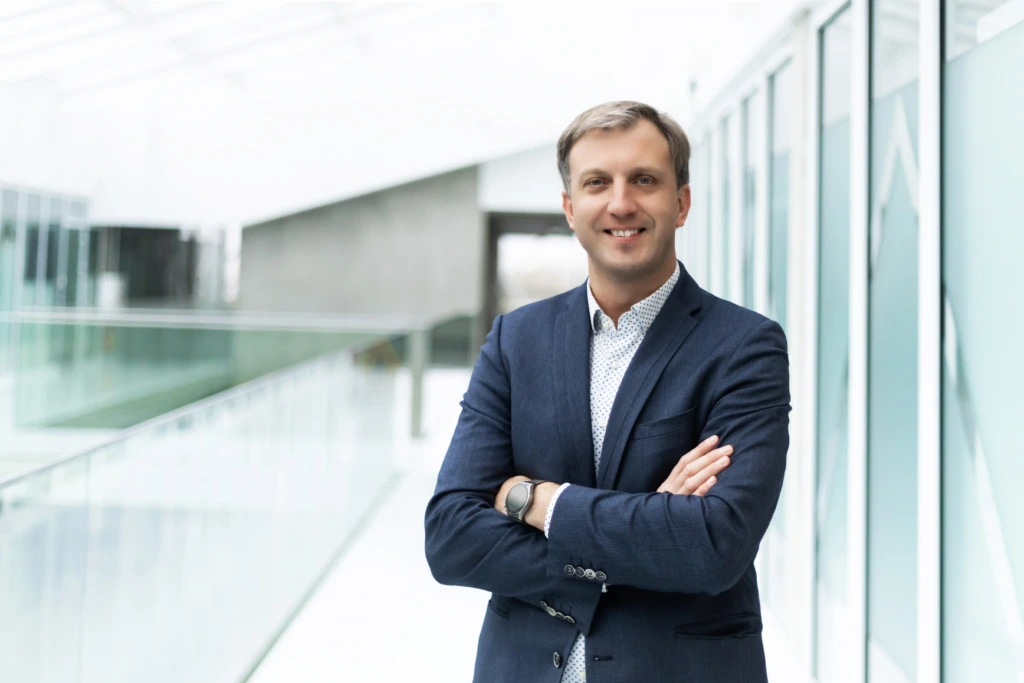
“Even today, in a virtual factory, using automated digital twins of machine tools, it is possible to create a digital copy of a shoe. Then you can calculate how long production will take, assess how long it can run without failures, and train new employees in a virtual environment. All of this can be achieved even before any concrete is poured for the construction of a real factory,” says Raudonis.
Although virtual copies of equipment already exist, creating a digital twin of a human would require much more effort. Raudonis explains that a true digital human twin would need to reflect biological, physiological, neurological, and psychological processes, as well as signs of consciousness. For this reason, only partial modelling of human processes is possible at the moment – for example, it is possible to create a digital twin of the human circulatory system.
“What is interesting is that if these twins were built based on a real person, they would have to take on not only physiological and biological processes, but also personality traits and character – including weaknesses. One of them is laziness,” notes Raudonis.
An AI-based “virtual self” – just an imitation?
Over the past 20–30 years, the relationship between people and technology has changed significantly. In the past, computer systems displayed images, played sounds and simply followed user commands. Today, they can observe the user, collect data and analyse the information gathered.
“Based on this, these systems can detect your mood, how many times and how intensely you press buttons, and what kind of music you listen to most often. All this data turns into something that resembles a personalised assistant,” says Raudonis.
According to the SustAInLivWork expert, this is also visible in everyday examples: Google search automatically completes your query, e-commerce websites show products on the first page that the user is likely to buy, and ads related to an upcoming holiday destination appear in the sidebar.
AI language models can already write emails on a person’s behalf, imitating their writing style and tone. In the digital space, these language models can gather all existing information about a user, read the books they are reading, or analyse their Facebook profile in order to generate replies based on the comments they write. According to Raudonis, this is not a copy of human consciousness.
“This is not your own digital twin – it is an algorithm that, based on probability theory, can reproduce your behaviour quite accurately,” says Raudonis.
A human digital twin for testing dangerous scenarios
The main challenge in creating a digital twin of a person is the risk that the technology could be used for manipulation. According to the SustAInLivWork researcher, digital twins could be used to create false, highly convincing information tailored to a specific audience – information that could influence the opinions and behaviour of an individual or a group of people. For example, by hiding behind a fake identity, someone could deceive others and gain financial benefit.
“People who create this type of information aim to divide society, artificially stir tension between different groups, or simply profit illegally,” says Raudonis.
However, if the idea of a human digital twin were implemented while managing these risks, a person’s “second self” could contribute to human progress – allowing us to make predictions and test different scenarios that are dangerous for humans. For example, what would happen if a person travelled on a long journey to Mars, how long-term radiation would affect tissues, or how long a person could remain without social contact.
“Such a digital twin, equipped with a modern language model, could take your place in the social space. But would you want to watch your own copy collecting ‘likes’ on social media?” Raudonis asks with a smile.
In fact, this could bring more than one science fiction film scenario to life: digital twins, having “realised” they can function without their real-world twin, would stop serving as an extension of human abilities and become independent personalities. Still, according to the professor, we are far from that turning point.
“We don’t know a lot. We need to answer questions such as: what is consciousness, why do mitochondria in our cells stop producing adenosine triphosphate (ATP), how does beautiful music affect our emotions and, in general, what is beautiful music? We don’t know much about ourselves, so for now, in a virtual environment, we can only change our clothes and hairstyle. And that is still very far from a digital twin of a human,” the professor concludes.
The SustAInLivWork project is co-funded under the European Union’s Horizon Europe programme under Grant Agreement No. 101059903 and under the European Union Funds’ Investments 2021–2027 (project No. 10-042-P-0001).