


Author, Institution: Vytautė Šmakova, Kaunas University of Technology
Science area, field of science: Social Sciences, Management, S003
Research Supervisor: Prof. Dr. Žaneta Gravelines (Kaunas University of Technology, Social Sciences, Management, S003)
Dissertation Defence Board of Management Science Field:
Prof. Dr. Asta Savanevičienė (Kaunas University of Technology, Social Sciences, Management, S003) – chairperson
Prof. Dr. Ilona Bučiūnienė (ISM University of Management and Economics, Social Sciences, Management, S003)
Assoc. Prof. Dr. Agnė Gadeikienė (Kaunas University of Technology, Social Sciences, Management, S003)
Assoc. Prof. Dr. Tomas Kincl (Prague University of Economics and Business, Czech Republic, Social Sciences, Management, S003)
Prof. Dr. Aušra Rūtelionė (Kaunas University of Technology, Social Sciences, Management, S003)
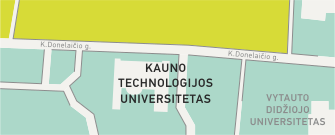
Dissertation defence meeting will be at Rectorate Hall of Kaunas University of Technology (K. Donelaičio 73-402, Kaunas)
The doctoral dissertation is available at the library of Kaunas University of Technology (Gedimino 50, Kaunas)
© V. Šmakova, 2025 “The text of the thesis may not be copied, distributed, published, made public, including by making it publicly available on computer networks (Internet), reproduced in any form or by any means, including, but not limited to, electronic, mechanical or other means. Pursuant to Article 25(1) of the Law on Copyright and Related Rights of the Republic of Lithuania, a person with a disability who has difficulties in reading a document of a thesis published on the Internet, and insofar as this is justified by a particular disability, shall request that the document be made available in an alternative form by e-mail to doktorantura@ktu.lt.”
Annotation: The dissertation investigates how consumers’ religiosity, spirituality and minimalism affect sustainable consumption behavioral intentions. Based on the belief compatibility theory, a model is developed in which consumer minimalism acts as a mediating mechanism between religiosity, spirituality and sustainable consumption behavioral intentions. The study is based on a post-positivist approach and PLS-SEM analysis (N=512). It has been confirmed that spirituality significantly increases consumer minimalism and has both a direct and indirect effect on sustainable consumption behavioral intentions. Consumer minimalism is also an independent, moderate predictor of sustainable consumption behavioral intentions. Religiosity does not promote consumer minimalism, its effect on sustainable consumption behavioral intentions is weak and only direct. The scientific novelty of the dissertation is an integrated model of religiosity, spirituality and consumer minimalism and an empirically based mediation of consumer minimalism. Practical implications – recommendations for policymakers, education, business and NGOs – value-based communication, integration of spirituality and consumer minimalism in educational and marketing decisions, promoting sustainable consumption. The dissertation complements research on consumer behavior and sustainability by showing that intrinsic values, in this case spirituality, promote sustainable consumption behavior intentions through consumer minimalism.