Author, Institution: Vaidotas Gudžiūnas, Kaunas University of Technology
Science area, field of science: Technological Sciences, Mechanical Engineering, T009
Research supervisor: Assoc. Prof. Dr. Aurelijus Domeika (Kaunas University of Technology, Technological Sciences, Mechanical Engineering, T009)
Dissertation Defence Board of Mechanical Engineering Science Field:
Prof. Dr. Hab. Vytautas Ostaševičius (Kaunas University of Technology, Technological Sciences, Mechanical Engineering, T009) – chairperson
Prof. Dr. Renata Balnytė (Lithuanian University of Health Sciences, Medical and Health Sciences, Medicine, M001)
Prof. Dr. Giedrius Janušas (Kaunas University of Technology, Technological Sciences, Mechanical Engineering, T009)
Prof. Dr. Vytautas Jūrėnas (Kaunas University of Technology, Technological Sciences, Mechanical Engineering, T009)
Prof. Dr. Aleksejs Kataševs ((Riga Technical University, Latvia, Technological Sciences, Mechanical Engineering, T009)
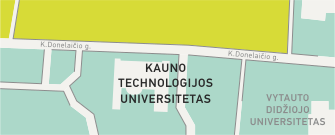
Dissertation defence meeting will be at Rectorate Hall of Kaunas University of Technology (K. Donelaičio 73-402, Kaunas)
The doctoral dissertation is available at the library of Kaunas University of Technology (Gedimino 50, Kaunas)
© V. Gudžiūnas, 2026 “The text of the thesis may not be copied, distributed, published, made public, including by making it publicly available on computer networks (Internet), reproduced in any form or by any means, including, but not limited to, electronic, mechanical or other means. Pursuant to Article 25(1) of the Law on Copyright and Related Rights of the Republic of Lithuania, a person with a disability who has difficulties in reading a document of a thesis published on the Internet, and insofar as this is justified by a particular disability, shall request that the document be made available in an alternative form by e-mail to doktorantura@ktu.lt.”
Annotation: The dissertation presents the development of a human postural control assessment system: from investigations of suspended-platform mechanics to an automated prototype. The work comprises five parts: mechanical investigations, modelling, biomechanical and neurobiomechanical analyses, and prototype development. Experimental studies established the platform’s horizontal stiffness and oscillation damping as quantitative descriptors of different instability levels. Modelling established how suspension geometry affects force distribution and the dynamics of human–platform interaction. The biomechanical analysis characterised how the interaction between the centre of mass and the base of support changes throughout sway at different instability levels. The neurobiomechanical analysis established that combinations of instability levels and sensory information strategies produce controllable postural destabilisation, ranging from barely perceptible to critical levels that require the recruitment of other compensatory strategies. After evaluating the informativeness of the biomechanical measures, mean centre-of-pressure velocity was selected for real-time assessment of task difficulty and determination of a safety threshold. The prototype developed from these findings automatically adjusts instability levels, records biomechanical measures, and terminates the test when the threshold is exceeded. The system provides a basis for a new generation of postural control studies in which the intensity of natural body sway is modulated in a controlled manner by combining sensory information strategies and mechanical instability levels, without additional external perturbations.
28th of August, 2026, 11:00
Rectorate Hall of Kaunas University of Technology (K. Donelaičio 73-402, Kaunas)
Add to iCal