



Author, Institution: Mustafa Muthanna Najm Shahrabani, Kaunas University of Technology
Science area, field of science: Technological Sciences, Civil Engineering, T002
Research supervisor: Prof. Dr. Rasa Apanavičienė (Kaunas University of Technology, Technological Sciences, Civil Engineering, T002)
Dissertation Defence Board of Civil Engineering Science Field:
Prof. Dr. Andrius Jurelionis (Kaunas University of Technology, Technological Sciences, Civil Engineering, T002) – chairperson
Prof. Dr. Hab. Artūras Kaklauskas (Vilnius Gediminas Technical University, Technological Sciences, Civil Engineering, T002)
Prof. Dr. Darius Pupeikis (Kaunas University of Technology, Technological Sciences, Civil Engineering, T002)
Prof. Dr. Žaneta Stasiškienė (Kaunas University of Technology, Technological Sciences, Environmental Engineering, T004)
Assoc. Prof. Dr. Kjeld Svidt (Aalborg University, Denmark, Technological Sciences, Civil Engineering, T002)
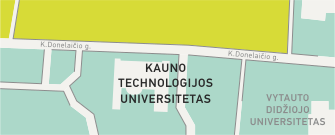
Dissertation defence meeting will be at Rectorate Hall of Kaunas University of Technology (K. Donelaičio 73-402, Kaunas)
The doctoral dissertation is available at the library of Kaunas University of Technology (Gedimino 50, Kaunas)
© M. M. N. Shahrabani, 2026 “The text of the thesis may not be copied, distributed, published, made public, including by making it publicly available on computer networks (Internet), reproduced in any form or by any means, including, but not limited to, electronic, mechanical or other means. Pursuant to Article 25(1) of the Law on Copyright and Related Rights of the Republic of Lithuania, a person with a disability who has difficulties in reading a document of a thesis published on the Internet, and insofar as this is justified by a particular disability, shall request that the document be made available in an alternative form by e-mail to doktorantura@ktu.lt.”
Annotation: This dissertation develops an evaluation framework for assessing smart building integration within the smart city ecosystem by examining the interrelationships among technological, environmental, and operational dimensions. The study addresses the existing research gap caused by the lack of a comprehensive and standardised approach for evaluating the contribution of smart buildings to broader smart city objectives. The proposed framework is built upon three primary dimensions: efficiency, resilience, and environmental sustainability. A systematic literature review was conducted to identify the key indicators and services that enable smart building integration. Subsequently, a dataset containing implemented smart building services was developed and analysed using artificial intelligence and machine learning techniques to classify integration levels and evaluate the significance of individual features. Six machine learning models were investigated, and the Support Vector Regression (SVR) model demonstrated the highest predictive performance. Feature importance analysis was further employed to identify the factors that most strongly influence integration performance and to provide recommendations for improving smart building contributions to smart city development. The findings demonstrate that integrating artificial intelligence into evaluation processes can enhance decision-making, support evidence-based planning, and facilitate the development of more efficient, resilient, and environmentally sustainable urban environments. The proposed framework provides researchers, policymakers, urban planners, and building stakeholders with a practical tool for assessing and improving smart building integration within future smart cities.