


Author, Institution: Gintautas Tamošaitis, Kaunas University of Technology
Science area, field of science: Technological Sciences, Civil Engineering, T002
Research supervisor: Prof. Dr. Danutė Vaičiukynienė (Kaunas University of Technology, Technological Sciences, Civil Engineering, T002)
Dissertation Defence Board of Civil Engineering Science Field:
Prof. Dr. Andrius Jurelionis (Kaunas University of Technology, Technological Sciences, Civil Engineering, T002) – chairperson
Assoc. Prof. Dr. Karel Dvorak (Brno University of Technology, Czech Republic,
Technological Sciences, Civil Engineering, T002)
Prof. Dr. Džigita Nagrockienė (Vilnius Gediminas Technical University, Technological Sciences, Materials Engineering, T008)
Prof. Dr. Žymantas Rudžionis (Kaunas University of Technology, Technological Sciences, Civil Engineering, T002)
Assoc. Prof. Dr. Ramunė Žurauskienė (Vilnius Gediminas Technical University, Technological Sciences, Materials Engineering, T008)
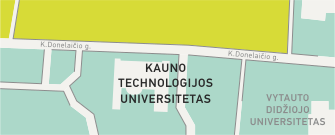
Dissertation defence meeting will be at Rectorate Hall of Kaunas University of Technology (K. Donelaičio 73-402, Kaunas)
The doctoral dissertation is available at the library of Kaunas University of Technology (Gedimino 50, Kaunas) and on the internet: G. Tamošaitis el. dissertation.pdf
Annotation: Municipal solid waste incineration bottom ash is a by-product generated in significant quantities, and its utilization has become an important environmental and economic challenge. This study investigates the composition and properties of bottom ash, as well as its potential application in the production of alkali-activated binders and concretes. Particular attention is given to metallic aluminum present in the ash, which induces undesirable chemical reactions and negatively affects the structure and performance of the materials. The aim of the research is to determine the formation principles of alkali-activated bottom ash composites and to evaluate the influence of key mixture parameters on their properties. The effects of the water-to-solid ratio and pH level on compressive strength, density, and porosity are analyzed. The results show that these parameters significantly influence both the reaction mechanisms and the final structure of the material: higher water content and elevated pH increase porosity, while lower water content promotes the formation of a denser structure. Three types of alkali-activated composites are examined: porous materials, dense materials, and vibro-pressed concrete. The study demonstrates that by optimizing mixture composition and using additives, it is possible to control undesirable reactions and produce materials with different properties. The results confirm that bottom ash can be effectively used as a secondary raw material in construction, reducing waste disposal and contributing to the development of sustainable building materials.