Author, Institution: Giedrius Jomantas, Kaunas University of Technology
Science area, field of science: Technological Sciences, Energetics and Power Engineering, T006
Research Supervisor: Assoc. Prof. Dr. Kęstutis Buinevičius (Kaunas University of Technology, Technological Sciences, Energetics and Power Engineering, T006)
Dissertation Defence Board of Energetics and Power Engineering Science Field:
Chief Researcher Dr. Hab. Algirdas Kaliatka (Lithuanian Energy Institute, Technological Sciences, Energetics and Power Engineering, T006) – chairperson
Prof. Dr. Hab. Gintautas Miliauskas (Kaunas University of Technology, Technological Sciences, Energetics and Power Engineering, T006)
Chief Researcher Dr. Rolandas Paulauskas (Lithuanian Energy Institute, Technological Sciences, Energetics and Power Engineering, T006)
Prof. Dr. Martin Seemann (Chalmers University of Technology, Sweden, Technological Sciences, Energetics and Power Engineering, T006)
Assoc. Prof. Dr. Egidijus Zvicevičius (Vytautas Magnus University, Technological Sciences, Environmental Engineering, T004)
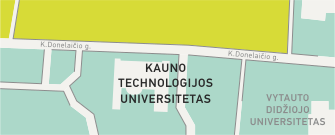
Dissertation defence meeting will be at Rectorate Hall of Kaunas University of Technology (K. Donelaičio 73 – 402, Kaunas)
The doctoral dissertation is available at the library of Kaunas University of Technology (Gedimino 50, Kaunas) and on the internet: G. Jomanto el. dissertation.pdf
© G. Jomantas, 2026 “The text of the thesis may not be copied, distributed, published, made public, including by making it publicly available on computer networks (Internet), reproduced in any form or by any means, including, but not limited to, electronic, mechanical or other means. Pursuant to Article 25(1) of the Law on Copyright and Related Rights of the Republic of Lithuania, a person with a disability who has difficulties in reading a document of a thesis published on the Internet, and insofar as this is justified by a particular disability, shall request that the document be made available in an alternative form by e-mail to doktorantura@ktu.lt.”
Annotation: The influence of combustion regimes on the formation of sulfur and nitrogen oxide emissions is analysed in the dissertation. In the scientific literature the focus is mostly on individual processes of pollutant formation, however, these processes are connected to each other in the furnace and reacts directly to the properties of combustion regime. The main objective of the dissertation is to investigate the influence of the factors of combustion technology (staged combustion, reductive environment, air staging, flue gas recirculation etc.) on the formation of sulfur and nitrogen compounds, hydrocarbons during biomass combustion. It was determined in the studies that greater concentrations of CO and return of recirculated flue gas to the combustion chamber results in the increase of SO2 concentrations up to the values similar to the theoretical values of oxidation of fuel sulfur to sulfur dioxide. The studies allowed to determine that factual emissions of SO2 can be significantly lower than those estimated by using the current methods of calculation of emissions, therefore an updated method of calculation of SO2 emissions was proposed, taking into account the operational combustion parameters of solid biomass-firing boilers. In addition, the conducted investigations enable the determination of sulfur bound in fly ash compounds along the flue gas path, contributing to the mitigation of adverse effects on combustion equipment.
14th of April, 2026, 10:00
Rectorate Hall of Kaunas University of Technology (K. Donelaičio 73 - 402, Kaunas)
Add to iCal