Author, Institution: Ernest Bykov, Lithuanian Energy Institute
Science area, field of science: Technological Sciences, Energetics and Power Engineering, T006
Scientific Supervisor: Chief Researcher Dr. Rolandas Paulauskas (Lithuanian Energy Institute, Technological Sciences, Energetics and Power Engineering, T006)
Dissertation Defence Board of Energetics and Power Engineering Science Field:
Prof. Dr. Hab. Algirdas Kaliatka (Lithuanian Energy Institute, Technological Sciences, Energetics and Power Engineering, T006) – chairperson
Chief Researcher Dr. Viktorija Grigaitienė (Lithuanian Energy Institute, Technological Sciences, Energetics and Power Engineering, T006)
Prof. Dr. Dariusz Kardas (Polish Academy of Sciences, Poland, Technological Sciences, Energetics and Power Engineering, T006)
Prof. Dr. Artūras Kilikevičius (Vilnius Gediminas Technical University, Technological Sciences, Mechanical Engineering, T009)
Prof. Dr. Giedrius Laukaitis (Kaunas University of Technology, Technological Sciences, Materials Engineering, T008)
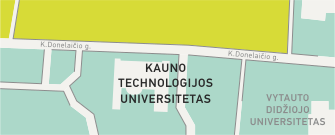
Dissertation defence meeting will be at the conference room at Lithuanian Energy Institute (Breslaujos 3 – 202, Kaunas)
The doctoral dissertation is available at the library of Kaunas University of Technology (Gedimino 50, Kaunas) and on the internet: E. Bykov el. dissertation.pdf
© E. Bykov, 2026 “The text of the thesis may not be copied, distributed, published, made public, including by making it publicly available on computer networks (Internet), reproduced in any form or by any means, including, but not limited to, electronic, mechanical or other means. Pursuant to Article 25(1) of the Law on Copyright and Related Rights of the Republic of Lithuania, a person with a disability who has difficulties in reading a document of a thesis published on the Internet, and insofar as this is justified by a particular disability, shall request that the document be made available in an alternative form by e-mail to doktorantura@ktu.lt.”
Annotation: While the use of renewable energy sources keeps growing, the utilisation of fossil fuels, e.g. combustion, still provides most of the world’s energy and will remain a primary source for many years to overcome constantly growing worldwide energy needs. An energy imbalance between demand and supply triggered a simultaneous energy crisis alongside environmental problems. The rapid depletion of fossil fuels has sparked growing interest in renewable energy sources and waste energy recovery. Due to growing energy needs, the development and application of technologies for deep and efficient utilisation of renewable energy sources, especially from waste, has become increasingly significant. One of the potential methods and technologies of energy production from renewable sources is the conversion or thermal utilisation (combustion) of low-calorific gases using auxiliary enhancement methods. As such, low-calorific gases of natural origin are typically considered those emitted by landfills when the stage is reached at which biomethane separation from landfill gas becomes economically infeasible. However, the main problem associated with the combustion of low-calorific gases, especially those containing a small amount of methane in the carbon dioxide stream, is their lower combustion efficiency and characteristics compared to pure combustible gases (e.g., methane) that are not diluted with non-combustible gases. It results in low combustion temperatures, a narrow flammability range, complex ignition, and unstable combustion (e.g., flame blowoff). Additionally, while the mixture has a high carbon content and low combustion temperatures, carbon monoxide emissions, known to result from incomplete combustion, are very high, and fuel utilisation is very low. These issues, related to the weak combustion characteristics of the heavily diluted combustible gases, result in utilisation methods that do not generate value-added products. Currently, the primary method for utilising low-calorific gases, especially those from landfills, is torch co-combustion with natural gas injection, which not only requires the use of fossil fuels but also emits CO2 and NOx. To avoid such drawbacks, the thermal utilisation of these gases requires additional external assistance. Plasma-assisted combustion increases combustion efficiency and stability, extends flammability limits for non-combustible gaseous mixtures under unassisted conditions, and reveals their energy potential. One of the positive aspects of such technology is the possible reduction in CO2 (greenhouse gas) emissions to the atmosphere. It was found that plasma assistance improves decomposition quality, increasing the mixture’s reactivity and generating additional highly reactive species. This, along with a reduction in the lift-off parameter, significantly affected combustion stability. Based on the empirical correlation, it is possible to control the combustion process by influencing temperature and flue gas emissions with plasma assistance.
17th of April, 2026, 10:00
Conference room at Lithuanian Energy Institute (Breslaujos 3 – 202)
Add to iCal