
Author, Institution: Dovilė Valantiejienė, Kaunas University of Technology
Science area, field of science: Social Sciences, Management, S003
Research Supervisor: Assoc. Prof. Dr. Lina Girdauskienė (Kaunas University of Technology, Social Sciences, Management, S003)
Dissertation Defence Board of Management Science Field:
Prof. Dr. Asta Savanevičienė (Kaunas University of Technology, Social Sciences, Management, S003) – chairperson
Prof. Dr. Renata Korsakienė (Vilnius Gediminas Technical University, Social Sciences, Management, S003)
Prof. Dr. Pascale Peters (Nyenrode Business University, the Netherlands, Social Sciences, Management, S003)
Prof. Dr. Eglė Staniškienė (Kaunas University of Technology, Social Sciences, Management, S003)
Prof. Dr. Živilė Stankevičiūtė (Kaunas University of Technology, Social Sciences, Management, S003)
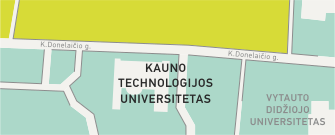
Dissertation defence meeting will be at Rectorate Hall of Kaunas University of Technology (K. Donelaičio 73-402, Kaunas)
The doctoral dissertation is available at the library of Kaunas University of Technology (Gedimino 50, Kaunas) and on the internet: D. Valantiejienė el. dissertation.pdf
© D. Valantiejienė, 2026 “The text of the thesis may not be copied, distributed, published, made public, including by making it publicly available on computer networks (Internet), reproduced in any form or by any means, including, but not limited to, electronic, mechanical or other means. Pursuant to Article 25(1) of the Law on Copyright and Related Rights of the Republic of Lithuania, a person with a disability who has difficulties in reading a document of a thesis published on the Internet, and insofar as this is justified by a particular disability, shall request that the document be made available in an alternative form by e-mail to doktorantura@ktu.lt.”
Annotation: The dissertation analyses the factors determining participation in gamification, the linkages among gamification and Agile team motivation in the context of organisations. The study aims to reveal how gamification affordances relate to Agile team motivation and the factors that influence employee participation in gamification. Based on the affordance approach, the dissertation develops a theoretical model that examines three interrelated components: employee participation motives, gamification and Agile team motivation, and in the empirical study, this model is supplemented with an element of cost-benefit assessment, which allows for a more accurate explanation of employee participation in gamification and the functioning of gamification in Agile teams. The study uses a qualitative methodological approach. The comparative case analysis performed allowed for the identification of motivational needs characteristic of Agile teams, the expression of gamification affordances and their links with the satisfaction of team motivational needs. Empirical results revealed that sociability and team achievement affordances are most closely associated with the satisfaction of team focus and psychological safety needs, while individual achievement affordances more often lead to passive participation in gamification. In addition, gamification decisions that are not aligned with the team context may be associated with unmet Agile team motivation needs and limited employee participation. The scientific novelty of the dissertation is an empirically based model of the linkages among participation motives, gamification, and Agile team motivation, which reveals not only the links between gamification and Agile team motivation but also the logic of participation in gamification in the context of Agile teams. Based on the results of the study, recommendations are provided on how to apply gamification in Agile teams.